January 23, 2008

Is Warfare A Rational Choice for the Tuareg People?

Is Warfare a Rational Choice?

Those who would argue that all warfare is irrational or "wrong" and that the Tuareg rebels should put down their arms and just "be quiet" can learn something about human inequality and conflict.

Those who do not suffer inequality do not feel it.

Those who suffer from unequal treatment
and deprivation of life's most basic needs,

feel it intensely.

In the end,
if
these urgent concerns of the Tuaregs are not acknowledged
and if their voice is not heard,
because the government has isolated and suppressed the Tuaregs,
and if president Tanjda refuses to negotiate,

* the only meaningful thing that remains *
for the Tuaregs to do,
is to fight.

Read the analysis below to understand why.


January 21, 2008

Peace and Conflict: Why Is the MNJ Fighting?


Photo: Leaders of the Niger Justice Movement (MNJ). Photo credit: MNJ


Peace and Conflict: Why Is the MNJ Fighting?

When faced with a legitimate choice between fighting and not fighting, most of us would prefer not to have to take up arms and fight. Some people have no choice, and are conscripted into a national army to serve in the interests of our country -- sometimes for purposes that they personally may not support. Some people would not take up arms under any conditions whatsoever, whether to serve their country, or even in their own self-defense, even if it meant their demise.

There are those who question the major conflicts in the world today, and others who support them. In both categories, there are those who question the small-scale conflicts of sub-groups within a nation that have taken up arms against their own country.

Let's take a look at the Tuareg conflict to try to understand what the various opinions are, and why the rebels have taken up arms.

Peace Focused on Laying Down Arms

There are some who personally do not agree with taking up arms under any circumstances. You can see such views expressed in the Agadez-Niger Forum, for example, where numerous members argue for a "peace" focused on laying down arms -- both the rebels and the government. There, you will see people expressing the view that "peace" means no violence.

Peace Focused on Negotiations

For others, "peace" involves more than just laying down arms -- it requires negotiations: "Je souhaite aussi que le seul ancêtre (TANJA) qui refuse la paix soit contient de ce qu'il fait et qu'il appel au dialogue dans l'interêt de tous les nigeriens." (I also hope that Tandja, who rejects peace, is happy with what he is doing, and that he will call for dialogue in the interest of all Nigeriens.)

Peace Focused on Forgiveness, Tolerance, and Not Holding Grudges

And for others, "peace" is even more complex: "Nous ne saurons jamais progresser si nous n'avons cette hauteur de pardonner, de tolerer de débattre et de jetter la rancune dans la rivière." (We will never know how to progress if we don't forgive, tolerate debate, and throw away our grudges in the river.) Some people might take this perspective even further, to "turn the other cheek," and take the blows without resistance.

Peace Focused on Calm and Quiet

For yet others, "peace" involves a society that is stable, calm and "stays quiet." For example, one member posted: "Espérons que cette année sera synonyme de paix et de quiétude au Niger." (Let's hope that this year will be synonymous with peace and quiet in Niger.)


WHAT PEACE MEANS TO TUAREGS:

Patience Is a Major Virtue Among Tuaregs

For most Tuaregs, peace has all of the above meanings. Tuaregs are a very forgiving people. One of their core values is tezaydert -- Patience. Tuaregs feel it is very important not to react in anger, but to display calm at all times. One can see this in their interactions with one another. Tuareg parents do not beat their children or their wives -- something we see all too frequently in many other cultures, including America and Europe. Even in the case of adultery, a Tuareg husband does not beat or kill his wife, as is known to happen in many other societies. He may confront the male adulterer in a duel to settle his case. But he will not assault his wife or children. Tuareg men value patience above all else. Tuareg men feel it is extremely important to remain in control of their emotions, and to not display personal anger through physical violence, except very infrequently, man-to-man, in certain situations that call for the settlement of a serious score such as adultery. In Tuareg day-to-day life, there is a noticeable lack of displays of anger and violent behavior. This gives a very different feel to someone who has been raised in a culture where parents punish their children physically, and husbands slap and hit their wives. Tuaregs are rarely known to do that sort of thing. Such a physical outburst would upset the peace in a Tuareg household, and would result in a great deal of social ridicule across the community. Patience is one of the major priorities among Tuaregs. It's easy to understand how this is adaptive, since Tuaregs live in very small communities or camps of just a few households, and need for everyone to work together cooperatively for the survival and well-being of the group, and avoid inter-personal violence. Tuaregs value patience -- but patience can sometimes be pushed to an unbearable limit, and in the case of the current warfare, this is what has happened.

Tuareg Warfare

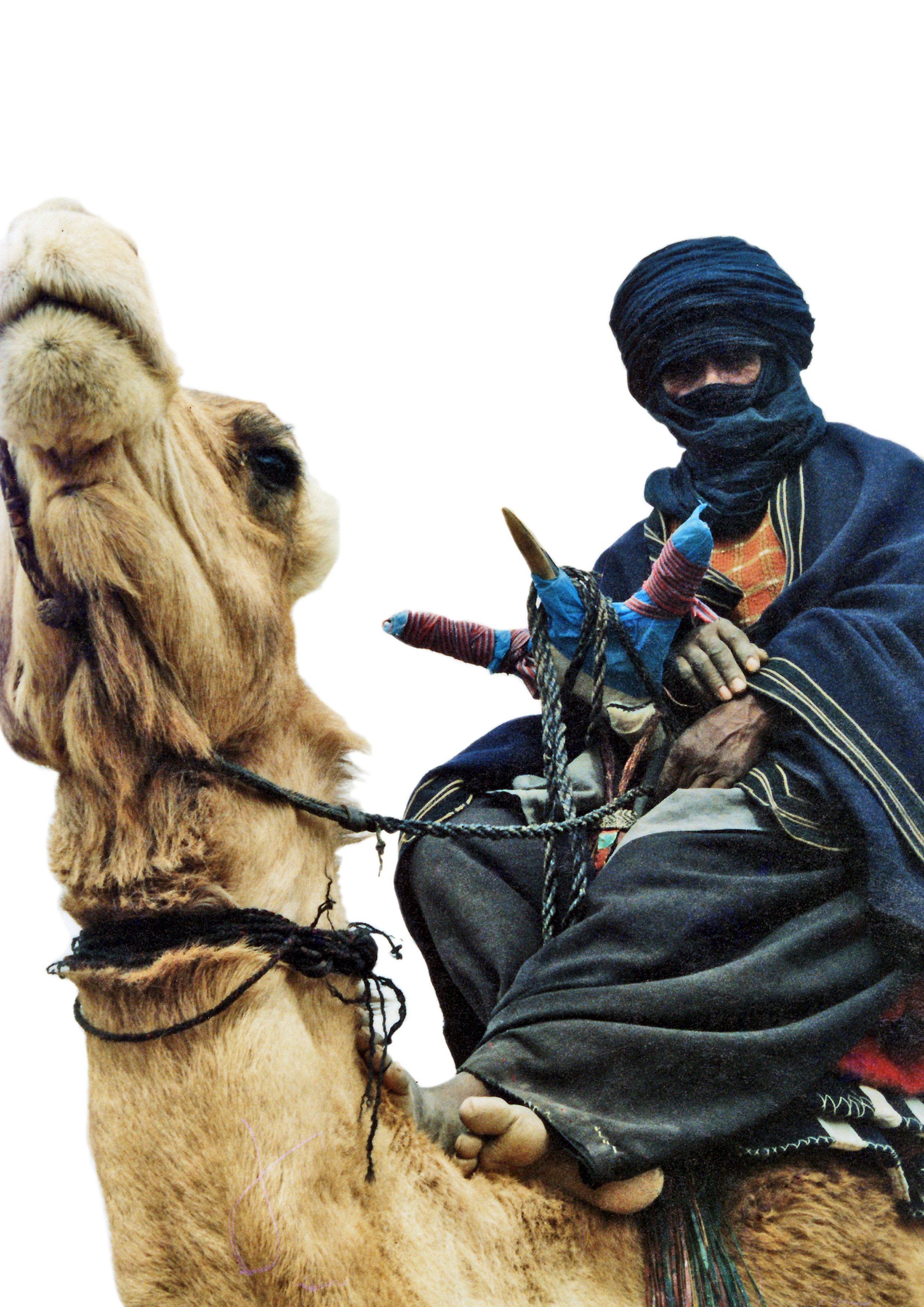
The Tuaregs have a history as renowned warriors, fighting in the past from atop their swift dromedaries in the Sahara, with swords and lances, and now with modern weaponry, showing great expertise and an inestimable knowledge of battle in the desert terrain. This is a different kind of violence from inter-personal violence within a community or household. There are very few societies in the world where the people do not fight to take or defend territory, or to control traffic through their lands, and the Tuaregs historically have been expert at warfare in the Sahara. We cannot make an exception of the Tuaregs based on their warfare, since nearly all societies practice warfare.

Those of us who disdain warfare on any grounds are apt to view Tuareg warfare as irrational or "wrong." In that case, we would also have to examine our own countries' practices of warfare and imperialist actions, and accept the fact that historically, Tuareg warfare has not been so different from our own wars. Those who view Tuareg warfare as "wrong" would likely be of the opinion that the warfare of any state is "wrong."

In the past, some warfare has been viewed as the right thing to do. For example, most Americans would agree that the War of Independence was the right thing to do. American Minutemen took up arms against the British colonizers and won their right to autonomy. Numerous other countries have a similar history, and many nations celebrate their Independence Day. Nearly all Americans felt that World War II was the right thing to do. Some Americans feel that the current warfare in the Middle East is the right thing to do, although some are not sure, and some disagree.

Why the Tuaregs Are Fighting Today

The Tuareg rebellions of the early 20th century were a form of resistance to colonization and oppression by the French.

The Tuareg rebellions of the 1990s were, in part, an attempt to gain an independent state comprised of traditional Tuareg territories in Mali and Niger, in response to marginalization and oppression by post-colonial governments.

The current Tuareg rebellions, however, are not aimed at establishing an independent country. They have taken up arms for other reasons, as citizens of modern democratic countries, Mali and Niger, to get some negotiations going, since normal channels of grievance haven't worked.

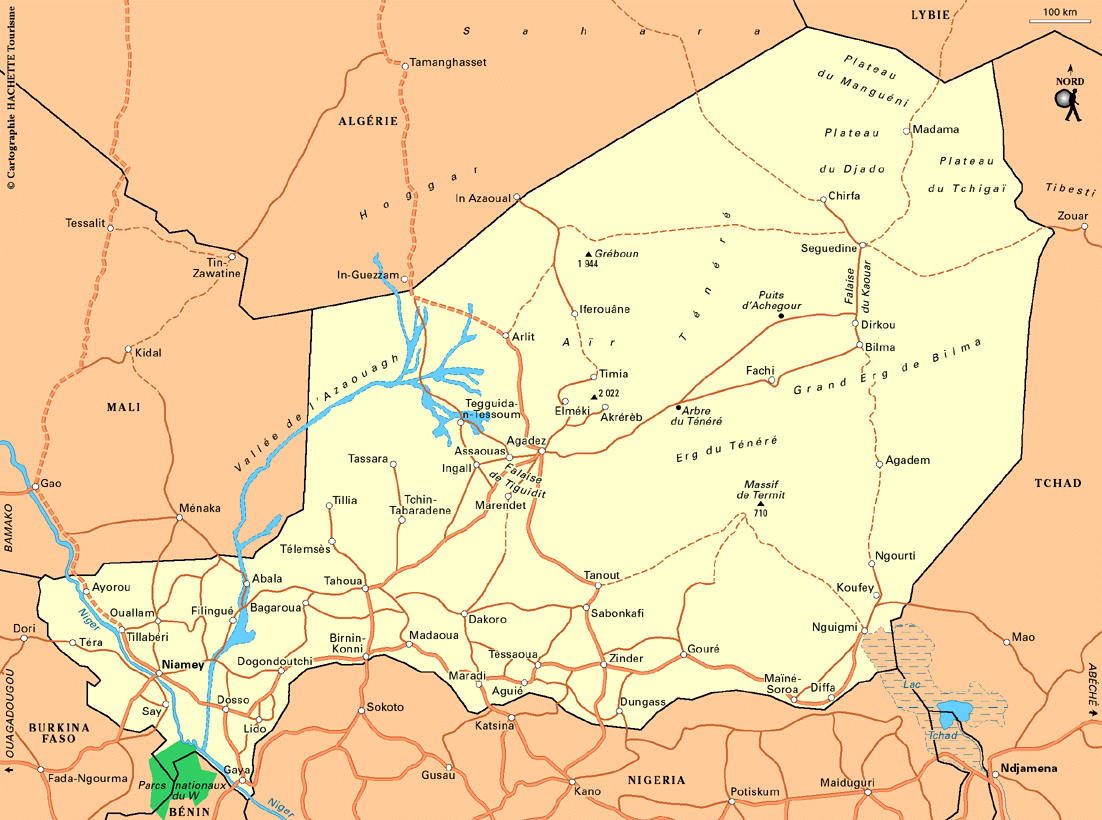
In Niger, the Tuareg-led Niger Movement for Justice is fighting for justice -- fair and equal treatment of all Nigeriens, and incorporation of the Tuareg people as equal citizens. The members of MNJ say that the Tuareg people have been treated very badly for some decades, and have been politically and economically marginalized within the country. The results of this ethnic marginalization can be seen in unequal distribution of development funds and relief aid. Schools, hospitals, wells, roads, and jobs are severely lacking in Tuareg territories. Niger is a very poor country, but the people who are getting the worst of it, according to MNJ, are the Tuareg people, because of their ethnicity. The Tuaregs feel this inequality especially, because they live on land that is rich in natural resources -- uranium and oil, among others. Niger is one of the foremost suppliers in the world today of uranium; the uranium is in the middle of Tuareg territories; and yet, the Tuaregs live in abject poverty, with high infant mortality, malnutrition, food insufficiency, lack of education and development, and joblessness. Their drinking water and pasture lands have become polluted from the radioactive waste that the uranium companies have spilled on their land.

The MNJ feels this situation should be rectified. Their rebellion in the 1990s resulted in negotiations, and a peace agreement that required the government to provide development, jobs, health care, education, and incorporation of Tuaregs into governance and the military. But thirteen years later, the government of Niger has not come through with their end of the agreement. The Tuareg people are still suffering, and there is no sign of any improvement. The government denies that there is any problem, and refuses to discuss it through normal, democratic channels.

Why Can't They Just Lay Down Their Weapons and Be Peaceful?

The Tuaregs have taken up arms *in desperation,* because they can't get a voice in their democratic country. They continue to be marginalized, nothing has been done to move forward with the terms of the peace agreement signed 13 years ago, the government won't listen to their problems, and they feel they simply have no other choice left to them.

To understand their perspective further, we can learn something from David Kaplan's article, "The Coming Anarchy" (1994). In his article, Kaplan discusses current conflicts around the world, particularly in Africa. Warfare has a lot to do with resource scarcity. And Niger is the Poorest Country in the World( IRIN, 2007; UNDP Human Development Report, 2006). Food insecurity is an annual problem.

In America, it seems inconceivable that a group would take up arms because they have insufficient resources, except perhaps in areas where people are living below the poverty level -- gang wars in impoverished inner-city ghettos, for example. Most of us eat three decent meals a day, and have an income that supports a lifestyle that is unfathomly luxurious by Nigerien standards.

Middle-class Americans and Europeans will find it shocking that "a large number of people on this planet, to whom the comfort and stability of a middle-class life is utterly unknown, find war and a barracks existence a step up rather than a step down" (Kaplan, 1994). As Martin van Creveld says in his book The Transformation of War, "Just as it makes no sense to ask "why people eat" or "what they sleep for," so fighting in many ways is not a means, but an end" (p. 161) -- fighting itself becomes the only meaningful act left in a society where people don't have enough to eat, and not enough basic needs are getting met such as jobs and health care.

Kaplan expresses it best in his "stretch-limo" analogy: "Think of a stretch-limo in the potholed streets of New York City, where homeless beggars live. Inside the limo are the air-conditioned post-industrial regions of North America, Europe, the emerging Pacific Rim, and a few other isolated places with their trade summitry and computer-information highways. Outside is the rest of mankind, going in a completely different direction" (Kaplan 1994).

In Niger, it's especially pressing on the Tuaregs, who live on land that is rich in resources -- worth millions in uranium revenues -- and yet they are denied any benefit. The government has shown itself to be seriously corrupt -- enough to result in a vote of no-confidence in 2007 (IHT, May 2007). MNJ alleges that the President, Tandja, has stolen uranium funds that were designated for development in the North, and put them in his own foreign bank account (MNJ, Dec. 9, 2007). Ethnic hostility has been heated up, MNJ alleges, through government "hate campaigns" against the Tuareg people on national TV, radio and on the Internet (MNJ, July 14, Sept. 27, Oct. 5, Nov. 1, Dec. 4, 2007). The government has sent its army out without proper direction, and the result has been illegal arrests, torture and massacres of innocent civilians (Amnesty International, and Human Rights Watch, Dec. 19, 2007). The government has isolated the Tuareg people from the media, and banned relief aid and humanitarian efforts from reaching them (IRIN, Dec. 10, 2007).

From the Tuareg perspective, they are being treated like prisoners on their own land. The resources are there, on their land, but they cannot receive any benefit. Humanitarian aid has been cut off to them. The rebels are men who have decided to try the only thing left that might help their people get a voice, fighting.

Is Warfare a Rational Choice?

Those who would argue that all warfare is irrational or "wrong" and that the Tuareg rebels should put down their arms and "be quiet" can learn something about human inequality and conflict. Those who do not suffer inequality do not feel it. Those who suffer from unequal treatment and deprivation of basic needs feel it intensely.

In the end,
if
these urgent concerns of the Tuaregs are not acknowledged
and if their voice is not heard,
because the government has isolated and suppressed the Tuaregs,
and if president Tanjda refuses to negotiate,
* the only meaningful thing that remains *
for the Tuaregs to do,
is to fight.


Sources:

Agadez-Niger Discussion Forum
Jan. 1, 2008.
http://www.agadez-niger.com/forum/viewtopic.php?t=2235&highlight
=

Amnesty International
Niger: Extrajudicial executions and population displacement in the north of the country.
http://www.amnesty.org/en/for-media/press-releases/niger-extrajudicial-executions-and-population-displacement-north-country
December 19, 2007.

IRIN
Niger Humanitarian access cut to north. Dec. 10, 2007.
http://allafrica.com/stories/200712101727.html

IRIN
Niger: Humanitarian Country Profile. February 2007.
http://www.irinnews.org/country.aspx?CountryCode=NE&RegionC

Human Rights Watch
Niger: Warring Sides Must End Abuses of Civilians. December 19, 2007
http://hrw.org/english/docs/2007/12/19/niger17623.htm
retrieved on the Internet on January 3, 2007

International Herald Tribune (IHT) - Associated Press
Niger's government dissolves after no-confidence vote. May 31, 2007.
http://www.iht.com/articles/ap/2007/06/01/africa/AF-GEN-Niger-Government-Dissolved.php

Kaplan, Robert D.
The Coming Anarchy. The Atlantic Monthly. Feb. 1994.
http://www.TheAtlantic.com/atlantic/election/connection/foreign/anarcf.htm

Niger Movement for Justice - Blog (MNJ)
The man worth 3.5 million. December 9, 2007.
http://www.m-n-j.blogspot.com/

UNDP
Human Development Report. 2006.
http://hdr.undp.org/xmlsearch/reportSearch?y=2006&c=*&t=*&k=&orderby=year

van Creveld, Martin
The Transformation of War. Free Press. 1991
http://www.amazon.com/Transformation-War-Martin-Van-Creveld/dp/0029331552/ref=si3_rdr_bb_product


January 17, 2008

Tuaregs: The Best-Kept Secret In the World


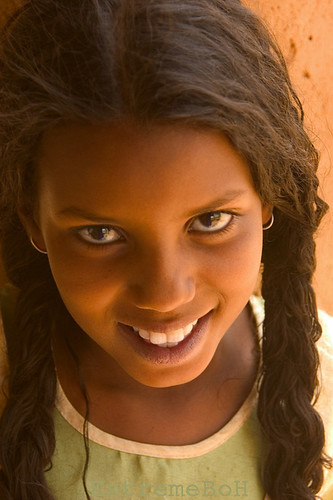
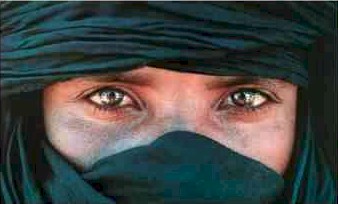
Photo of a lovely Tuareg girl in Niger, by professional photographer Jason Hall, extremeboh, on Flickr.


Tuaregs: The best-kept secret in the world

Europeans have been exotifying the Tuaregs for over a century. Tourist agencies feature posters of "The Blue Men," the fabulous remote Tuaregs, peeking through their "veils" mysteriously with grinning eyes, or sauntering along on swift white camels toward the remotest edges of the Martian-like Saharan landscape.

But today, you will not get to visit the Tuaregs in Niger, because Mamadou Tandja has closed the doors on them. They are a best-kept secret.

Something is going on up there in the North. There are nasty, horrible secrets that the Niger government doesn't want us to find out about. Every year, Amnesty International and Human Rights Watch have reported abuses of one sort or another in Niger, some of which may also be found in U.S. Country reports for Niger, but this past year it was particularly bad: The rights reports confirm that the government's army has been going around torturing and killing Tuareg civilians and livestock in the Air Mountains, and leaving mass graves in their wake.

Civilians in the Air have fled the area, leaving their homes in shambles. It is winter in the Sahara, and these families are huddling in the cold, in makeshift camps in the middle of the Sahara, far from their homes, with nothing to eat, in fear, with no hope forthcoming. The government closed off tourist traffic through the area months ago, banned humanitarian aid to the Tuareg people, and essentially declared that anyone who dared to report on the situation would face the death penalty. It's a secret!

For months, the Tuareg-led rebels kept posting messages on their website, pleading for journalists and rights groups to come interview them, and document the government's crimes against civilians. Tuareg civilians in the northern Air Mountains fled in fear of the army's predation on their villages. Because of the news blackout and government's gagging of the press, the only voice left for the Tuaregs was "The Voice of Free Men" -- the Niger Movement for Justice, the Tuareg rebels, who have a website where they regularly report on the developing situation. For months, they kept calling for help, for journalists, for human rights, to come there and see for themselves.

Voice of America reporter Phuong Tran somehow managed to get up to the North and traveled with the rebels for eleven days. Her report came out on Nov. 28. There were no photographs or videotapes, and very few details -- nothing about the army's arrests, torture, and execution of civilians. Most of her report could have been learned by reading the posts on the Niger Justice Movement's website. Her report was heavily guarded, to avoid conflict with Tandja's mandate. After all, it's a secret!

Human rights groups -- Amnesty International and Human Rights Watch -- went to Niger in December to investigate the abuses, but apparently, according to their reports issued on Dec. 19, it seems that they were held in Niamey, and never made it to Agadez or the Air Mountains to see for themselves, and interview the rebels and local people. It would appear that even the human rights groups were limited mainly to hearsay and the opinions of foreign diplomats on what the actual situation was. The bad stuff going on in the North is not to be seen by anybody, because the Niger government has isolated Tuareg regions from the rest of the world. Meanwhile, the army has continued to carry out its abuses, slaughtering Tuareg livestock, and terrorizing villagers (as reported on MNJ website). Most of the news about the rebels and the Tuareg population was based on what the MNJ rebel website was reporting, because that was the only voice left in the area. The rebels have been diligent, posting every few days on the army's abuses, accompanied with the grim photographs of mass graves.

Finally, two top-notch European reporters headed out there in early December, Thomas Dandois, and Pierre Creisson. They got permission to report on the bird flu in the south of Niger. Intrepid and daring, these two remarkable men, who recently produced brilliant coverage of the situation in Darfur, figured out a way to get to northern Niger. They found the rebels and they got the story, complete with camera footage. Tandja had his spies following them, and arrested them for interviewing the rebels. He has had them in jail for a month now, awaiting trials and the threat of execution. The Tuareg rebellion in the North is a big secret! And it's a taboo topic in the Niger news, unless reporters practice self-censorship and only say things that reflect the state's bias against the Tuaregs and their rebellion.

Over the past year, numerous reporters have tried to interview the rebels by telephone or through local contacts. But the government had at least 14 journalists arrested in 2007 (IRIN Jan. 14, 2007), for doing what they were trained to do -- and for doing what the Niger Constitution expressly allows them to do -- freedom of the press. Four reporters are languishing in jails right now, awaiting sentencing. Nigerien president Tandja Mamadou has threatened them with the death penalty. Although Niger is allegedly a democracy, and freedom of the press is an integral part of its constitution, Tandja has declared that no reporters shall report impartially on the Tuareg situation in the north, because such reporting is a "threat to security."

Finally, this week, the uranium mining company Areva was able to get a deal -- they paid 50% more this time around, to renew contracts to exploit Niger's uranium. And they vowed to "stay out of Niger's politics." No mention was made of hiring the local Tuaregs to work at the company, which is built on traditional Tuareg lands. No mention was made of making sure that the Tuareg regions would receive development funds -- something that was guaranteed by the Peace Accords of 1995. These are some of the most important reasons that the rebels have taken up arms: in the 13 years since rebels signed a peace agreement, the government has continued to marginalize the Tuareg people, and refuses to honor the terms of the Peace agreement.

The French administration longs for uranium, at such a cost -- the perpetuated impoverishment and cruel treatment of the people on whose lands they have squatted and taken their only riches, with no returns to the local Tuareg population.

Tandja and his cronies are lining their pockets with the uranium funds. They have stepped up the deals with numerous countries, to garner as many advances as possible before their time is up. According to MNJ, Tandja is ferreting public uranium funds designated for development in the North, into foreign bank accounts and real estate. Elections are coming up soon, Tandja is on his way out, and there's no time to waste. Other corrupt politicians may take his place in this racist, sadistic dictatorship.

France wants the uranium. Tandja wants to line his pockets, quickly. Other world powers don't want to interfere; they have their own interests to protect. They turn their heads on the horrors of what's going on in the North, and make deals with a minor Hitler of the third millennium.

SHAME ON AREVA! Shame on the world powers who sit in silence, while thousands of men, women and children are suffering because of your best kept secret!


With local and international reporters incarcerated and awaiting death sentences for even interviewing the rebels for their news reports,
who would dare speak out for justice
-- except for rebels?

"There is no voice of the people
that would dare speak out
against the current dictatorship."

-- Ahmed Akoli, political secretary for MNJ. December 21, 2007


Sources:

Amnesty International
Niger: Extrajudicial executions and population displacement in the north of the country.
December 19, 2007

Human Rights Watch (report)
Warring Sides Must End Abuses of Civilians.

Dec. 19, 2007

Mouvement des Nigeriens pour la Justice
Niger Movement for Justice Blog (MNJ)

Reuters -- Marie Maitre and Abdoulaye Massalatchi
Areva renews Niger uranium deal, pays 50 pct more.
January 14, 2008

UN Integrated Regional Information Networks
Niger: Press Harassment Hinders Development, Watchdogs Warn. January 15, 2008.


January 16, 2008

THREE PETITIONS for PEACE in NIGER

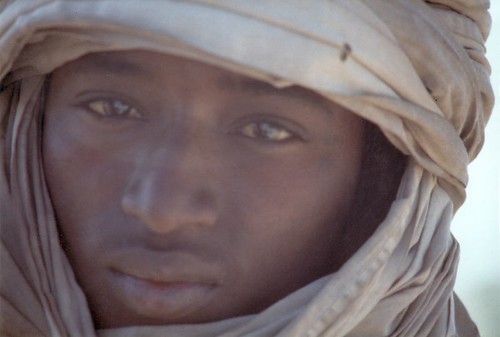
Photo: Tuareg 1989, by Antspin, on Flickr (Note: some rights reserved)

There are three different petitions circulating for Peace In Niger (one is in three languages, so five petitions total). So far, at least 1,979 individuals and organizations have signed the petitions. All the petitions are asking for essentially the same thing -- NEGOTIATION for PEACE in NIGER, and NO MORE VIOLENCE.

Summary of the Petitions for Peace In Niger:


Petition A "Appel À La Paix Au Niger" (French)

June 19, 2007 - Dec. 29, 2007

Original version: http://www.agadez-niger.com/forum/viewtopic.php?t=1422

Edited / current version: http://www.agadez-niger.com/forum/viewtopic.php?t=1628

Appel du 18 Juin 2007, Grenoble

Le Collectif en faveur d’une paix durable au Niger

604 signatures as of Dec. 29, 2007


Petition B "Petition for Peace In Niger" (English)

July 15, 2007 - Jan. 14, 2008

http://www.thepetitionsite.com/1/peace-in-niger

International Coalition for Peace in Niger

436 signatures as of Jan. 14, 2008 (petition was closed temporarily on Jan. 14, and may re-open)


Petition C "Peace In Niger" (French, English and German)

Includes Tuareg Associations and Human Rights Associations

FRANCAIS:
http://www.PetitionOnline.com/plpanf07/petition.html
French: 470 signatures


ENGLISH:
http://www.PetitionOnline.com/pinnne07/petition.html
English 185 signatures


DEUTSCH:
http://www.PetitionOnline.com/fidrnd07/petition.html
German 284 signatures

Total: 939 signatures as of Jan. 15, 2008


Total signatures of all of the petitions:

1,979 individuals and organizations


January 13, 2008

Tuaregs, two countries, two different situations


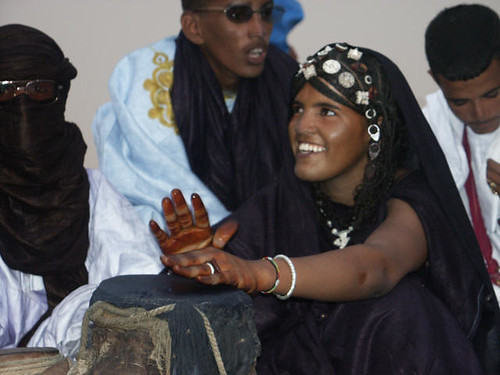
Photo: The Tuareg blues band Tinariwen performs on stage. They have numerous CD albums, which are available on Amazon.com Each year, Tinariwen hosts the Festival of the Camel, at Tessalit, in Mali. Photo credit: Slushpup, on Flickr


In Mali last night, Tuaregs just finished up with two international folk festivals. There's the Festival of the Camel, hosted by the Tuareg band Tinariwen, at Tessalit, and the Festival in the Desert, at Essakane, only 65 kilometers from Timbuktu. During the day, there are traditional Tuareg celebrations, including camel races, drumming and singing events performed by Tuareg women (tende), workshops and parades. At night there are concerts.

Thousands of Tuaregs, and several hundred tourists have been enjoying the music of numerous Tuareg blues and rock groups from Mali, Niger and Mauretania, as well as some other local bands, and even some imported ones. Imagine a band stage, with lights, a booming sound system and a vast audience, out the in the middle of the Sahara! The Essakane festivities feature a group of Eskimo (Inuit) performers all the way from Alaska.

Many of the members of the Tuareg bands were once rebels who originally met as refugees in Libya and Algeria in the late 60s, 70s and 80s. They have their CDs for sale on Amazon.com, and you can listen to selections of their music there. Many of the bands are listed below this post, under Contemporary Tuareg music.

If you want to go there next year, make an appointment for a yellow fever shot, get a visa, and start saving your cash -- several thousand dollars. Tuaregs and Europeans organized these festivities, and the Malian government helped sponsor it.

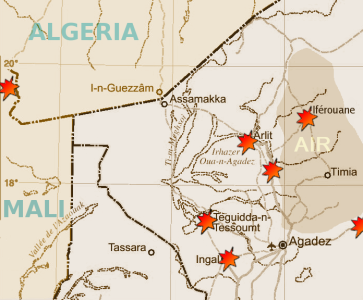
On the other hand, try to imagine a Tuareg village, Iferwan, just a few hundred miles away to the east, that became a ghost town only a few weeks ago. The people there fled south to Agadez, west to Arlit, and north to Algeria, because they were afraid of the Niger army.

In their country, Niger, the army has been hunting down, arresting, torturing and brutally murdering Tuareg civilians in their region, in retaliation for attacks by the Tuareg-led Niger Movement for Justice (MNJ), which has taken up arms to try and get negotiations for a better life for their people. Niger has always hovered at the bottom of the U.N. Human Development Index, where many people have to try to feed their families for about $1 a day (UN Common Database: 60.56% in 1995), and nearly everybody lives in desperate poverty.

The 2005 Niger Food Crisis brought world attention to the suffering in Niger, when many Americans will remember the broadcasts by CNNs Anderson Cooper, who went to Niger to document the "pencil stick" babies and starving people. In 2006, Niger was declared the Poorest County in the World. The Tuaregs have been economically marginalized, and have routinely been excluded from food relief, medical aid, and development funds for decades, since the country's independence.

Both Mali and Niger are poor, but the music festivals in Mali highlight the fact that the Malian government now seems in certain ways more favorable to acknowledging and including the Tuaregs. Even though rebel activities have recently been going on there, too, the Tuaregs in Mali can host these joyous festivals, and bring some cheer and acclaim to their people.

In Niger, no one is allowed to visit the Tuaregs, to see the dreadful conditions they are living in, and to hear their plight. The government stopped tourist traffic through Tuareg areas many months ago, banned Doctors Without Borders from the Agadez region, cut off shipments of food relief to Agadez from Libya, and has refused to allow relief workers and supplies into the area to help the Tuaregs.

There is a virtual news blackout on the situation, since the government has said that no one is allowed to give an honest report. The news is heavily filtered and manipulated, and in order to survive, newspapers and radio stations must practice self-censorship. Four reporters are in jail, awaiting possible death sentences for allegedly interviewing the rebels.

As recently as ten days ago (Jan. 3rd), according to MNJ, the Niger army moved through Tuareg villages in the North, shooting their livestock, and extorting them. The Tuaregs in Niger live in a climate of fear and repression.

Last week, a landmine blew up in Niamey, hundreds of miles from the conflict area, and killed a radio reporter. Some groups fear that Niger's clampdown on freedom of speech and of the press has gone from bad to worse. Has the government of Niger resorted to killing reporters, and instilling fear in the general population? The Niger Defense Minister has accused the Tuaregs of laying landmines in the cities (which they refuse), and he has called on citizens "to fight" against them.

The Niger army has gone out of control, killing Tuareg civilians and livestock. The government has, according to MNJ, been running hate campaigns against the Tuareg people on the national TV and radio stations. Various leaders have been talking about "finishing off" the rebels and "exterminating" the Tuaregs. The Defense Minister seems to be calling for some sort of civilian "vigilance brigades" or militias against the Tuareg rebels, since the national army hasn't been effective.

Where will it all end? Is the Niger government so corrupt and confused that it means to start another genocide like Rwanda's?

From being at the bottom of the world heap in terms of development and food security in 2006, Niger has risen to the top of the world list of abusers of human rights, as a "predator" on freedom of the press, according to the Media Foundation for West Africa (MNJ has a post addressing this topic).

What can be done? It's pretty grim -- 3,500 Tuareg men, women and children are huddled together far from their homes in a remote area of northern Niger, with nothing to eat, no shelter, no medical attention, and no way to get help, since the government has cut off the North from the usual American and European non-government organizations that would provide help.

But some Tuareg organizations are trying to pull together an emergency relief campaign, through local people. You can find out more about it by clicking on the following websites: Tchinagen and Targuinca


Tchinaghen: click HERE for ENGLISH

www.collectif-tchinaghen.org
tchinaghen@yahoo.fr

Telephone (from the U.S.) 011 (33) 6 28 O5 76 57

Telephone (from Europe) (33) (0) 6 28 05 76 57


You can also sign a PETITION FOR PEACE IN NIGER:

PETITION FOR PEACE IN NIGER


To view / sign the Petition, go to:


FRENCH:
http://www.PetitionOnline.com/plpanf07/petition.html

ENGLISH:
http://www.PetitionOnline.com/pinnne07/petition.html

GERMAN:
http://www.PetitionOnline.com/fidrnd07/petition.html