December 22, 2007

Ahmed Akoli (MNJ) - Exclusive Temoust Interview


Photo: Ahmed Akoli
Photo credit: MNJ

"The MNJ is campaigning for the advent of a united Niger in which each citizen is proud to be part of their country every day."

Temoust's exclusive interview with Ahmed Akoli, political secretary for the Niger Movement for Justice (MNJ).

Original interview, in French, is on the website of
Temoust and MNJ.
December 21, 2007

Temoust: Over the past few weeks we have witnessed a deterioration of the security and humanitarian situation in Niger. Dozens of civilians have been killed by Niger's army, which clearly has not been able to gain the upper hand over the Niger Movement for Justice (MNJ). On the political front, Niger is moving towards a chaos that seems inevitable if the authorities do not decide to take things seriously and to seek ways out of this crisis. . . .


Temoust: For nearly a year, your organization, the MNJ, has confronted Niger's army in the North. Can you tell us exactly what your Movement is demanding, and how you distinguish your group from those of the 1990's?


Ahmed Akoli: The first rebellions were initiated as a result of injustices done to the Tuareg community by the Niger authorities who succeeded to power. Citizens in the North had used all of the legal means to try and be heard at the time of their distress. They met only indifference and incomprehension on the part of Niger's political elite. It was after several attempts at solving the problems had failed that young fighters took up weapons, to be heard through force. This [the first Tuareg rebellion] followed the tragic events of the 1990's, including the killings at Tchintabaraden [1990] and others that have remained unpunished to this day, continuing the crisis. At that time, the rebellion mainly affected the North, and the demands revolved around the establishment of a federal system.


It was after five years of conflict that the rebel movements and the state joined in negotiations that culminated in signing the Peace Accords of April 24, 1995. These agreements, unfortunately, were never respected by the Niger government. In essence, the question remains the same [in this rebellion]. We denounce the injustice done to Nigeriens who have been marginalized and reduced to the status of second class citizens. It's about Nigeriens whose regions have received no socioeconomic benefit, despite the significant quantities of resources that have been exploited [from regions in the North]. It's about citizens who have been peripheralized, even though they constitute the second largest component of the nation, according to the latest census of the population, which the powerful elites curiously refuse to publish. The MNJ has no territorial claims, and requests that the rights of every Nigerien should be acknowledged. MNJ includes combatants from all ethnic groups and from all regions of Niger. Because of the marginalization suffered by the people of northern Niger and the great injustices done to the region and to the communities who live there, citizens of the North are the most numerous in our endeavor and in the direction of the Movement.


The MNJ, no matter what its critics say, is a national movement and its fighters intend to claim their full citizenship. There are several ways to look at Niger, and many Nigerians can not accept the current situation, one of great disparities in regional development that have been deliberately created [by the government]. For us, it is high time to correct this situation and restore a balance, which is the only guarantee of a just and lasting peace for the country.


Niger must be managed collegially by all the nation's communities, and it should not be a gift given to some, or a luxury that can offered to others, but a legitimate right and a prerequisite for stability.


Temoust: Today, how do you see the situation, in view of the authorities' refusal to negotiate with you? Can your claims can be heard and find solutions through the democratic system?


Ahmed Akoli: Niger is only a facade of democracy, since the State has been unable to build stable institutions. The country is plagued by arbitrariness and corruption in its management; both the political majority and the opposition agree on this issue. Since Independence, [the Niger government] has been a system based on ethnic and regional cronyism. Bloody crimes and other political offenses and abuses are rarely brought to justice, which casts discredit on the state and its Justice system. These affairs are often used to settle scores between powerful clans, as we have seen in recent days. Freedom of the press is restricted, and journalists are silenced and imprisoned under false pretences. There is no voice of the people that would dare speak out against the current dictatorship.


Temoust: What is the position of your Movement in relation to the peace accords signed in 1995 between the Tuareg movements and the government of Niger?


Ahmed Akoli: The peace accords of 1995 were a significant step forward in resolving the problem in the North. But the lack of political resolve and the bad faith that has characterized the attitude of those in power has prevented the effective implementation [of the peace accords]. The [peace accords] represent a major legal right for the country as a whole.


It is undeniable that the rebellion of the '90s has led to decentralization, of which all Nigeriens are proud, and which they see as an indisputable democratic achievement. This decentralization, however, remains unfinished and the means for accomplishing it remain paltry. Thus, several municipalities were unable to establish themselves, or soon ceased to function. A number of mayors and elected officials threw in the towel and some have returned to MNJ to denounce the state's inertia. In addition, there are those in power who manipulate these communities through the regional governors, who make and unmake laws as they please, to the detriment of true democracy at the grassroots level. Yet decentralization constitutes a hope and an effective means of adjusting policy to the real needs of the people. That is the only way to take into account of the social-political configuration of each region, by addressing their economic, demographic and cultural specifics. One should note that there are important variations in administration, depending on whether it's a region that's oriented toward sedentary agriculture, or one that is located in pastoral and nomadic areas.


Over the last 40 years, the successive regimes in Niger have been characterized by the clear intention of strangling the North and the communities that live there. The entire population is now aware of this situation and the state can no longer continue the same policy without endangering national unity.


The political class must take into account the multiethnic reality of our country, so that each of our communities can flourish according to its specific culture. This would further consolidate our national unity. It is incumbent upon the State to guarantee fairness and equality of citizens before the law and ensure the balance necessary for national cohesion. It is a pragmatic and realistic way of understanding the reality of our country. The state must stop hammering its demagogic and hypocritical discourse that fails to bring about national unity and social justice, because when these values are actually experienced, there's no need to cry out loud and strong. The birth of rebellions in Niger is justified by the inability of politicians to diagnose the disease that's rampant, and to find a solution other than punishing these uprisings at all costs through weapons. The monopoly of violence belongs to the State legitimately only when it fulfills its mission vis-à-vis its citizens.


Temoust: Your struggle for justice does not seem to meet the support one should expect on the part of Niger's civil society?


Ahmed Akoli: Civil society is not by definition a particular organization, it's the way of the people. The vast majority of Nigerians want peace and have been making regular appeals to the government to enter a rational dialogue. These appeals are routinely rejected by those who hold power. The government has created its own "civil society" to which it gives a monopoly in public debate. This policy was pushed to unacceptable levels, when a minister of the Republic in his full capacity participated in a debate organized by the national television station, in which a character known for his extremism called for the extermination of one sector of the national community.


Such an attitude runs counter to the desire of Nigeriens to build a common destiny.


Temoust: Why don't you seek to enter your struggle into the democratic process, which was beginning to lead to decentralization and the birth of political parties?


Ahmed Akoli: There are problems that can not find solutions in a system where the dice are rigged in advance. The apparatus of state and its institutions have remained the same since the country's Independence, and are in the hands of an ethnic and regional oligarchy that bases its strength on its tribalistic army. The current political class has caused enormous harm to the country, by including in the Constitution an amnesty to the assassins of President Baré, thus accrediting it with the issue of its [the political class's] complicity in the crime. This malfeasance has the effect of weakening the state's image to its citizens - an image already severely shaken by corruption in all our institutions to the point where no one wonders how a mere civil servant may become a millionaire within a few years.


Democracy is always a goal to which we must aspire, but which is never attained because it implies human perfection … However, in order to function, a State needs rules that citizens view as fair and just. In Niger we have to build these rules and MNJ wants to help create conditions for the debate. Nigerians who value peace and justice must reinvent institutions adapted to our reality, with which every citizen can identify. After all, democracy is a choice of society, where the debate is based on ideas and not on our intrinsic differences of identity which can not be the subject of negotiation. With us, every community has brought its territory to form the current Niger, and its history is quite recent.


Human rights are being trampled by the State of Niger. Beyond their universal and sacred character, they [human rights] are a pillar that makes it possible to structure the idea of the state in a country like ours, where in reality a modern state largely remains to be built.


Temoust: The government accuses you of being traffickers and bandits. How do you respond to that?


Ahmed Akoli: For us, the accusations of those in power in Niamey can have no credibility, because the reality is that we have unmasked the real sponsors of these trafficking trades, which are actually to be found in the circles of political power. The MNJ can not accept for northern Niger to be given over to traffickers of all kinds and for it to become a foothold for adventurers in the service of foreign interests in the region.


Also, with regard to crime and delinquency, the government wants us to forget the billions that have been embezzled by its partisans, which could have been used to build schools or health clinics, or prevent Nigeriens from dying of hunger.


Temoust: Among your claims there is the issue of equitable distribution of the country's wealth. Can you tell us more?


Ahmed Akoli: Over the past 40 years that uranium has been exploited in our country, it has not served to ameliorate the living conditions of the local populations. The money from this uranium has not been used to dig water wells that would have alleviated the suffering of the people of the area. ... It has not served to educate the children, to create health clinics ... In the area of employment, the indigenous peoples of the region are not being hired, even for unskilled jobs. By contrast, the environmental risks associated with mining operations are becoming increasingly important. Many illnesses have emerged in recent years in the indifference of the state and the [French-owned] Areva Corporation, which is exploiting the two mines in use today. There, too, the MNJ can not accept the ongoing plundering of natural resources in the region, unless the interests of local populations are taken into account. We are demanding that Areva and the other multinationals interested in our wealth to respect us, and understand that things can no longer be like before.


The mineral wealth of our regions have been exploited so far in total obscurity, and Areva has been content to fatten the politico-military oligarchy in Niamey without worrying about the plight of the Tuareg populations.


Temoust: The government of Niger has been distributing [uranium] exploration licenses to multinationals in a frenetic manner - what are the consequences of this new policy on the populations?


Ahmed Akoli: We believe that the diversification of partners is a good thing in itself. But this should not be done on the backs of the people and the real interests of the country. Today, the one thing that's clearly at risk is the fate of the people who inhabit the areas concerned. Some families - even whole tribes - are ejected from their customary lands without any consultation or accompanying measures that could clarify the legal and material implications of these decisions. The people have been dispossessed of their vital habitats, which will have the effect of destabilizing the social and economic fabric of these regions. This also raises the question of grazing land already abused by the Rural Code, which gives de facto rights to sedentary peoples more than to nomadic pastoralists. It's an implicit means of sanctioning the supremacy of agriculture over livestock breeding, which is nevertheless the second udder of the national economy after mineral riches.


Temoust: Let's go back a bit, to the demands of MNJ.


Ahmed Akoli: Our document of demands is prepared and will be published in due course. These demands are fair, for they back up an unquestionable diagnostic of the situation in our country.

That is why they are shared by a majority of Nigerians, even if some are still living in illusion believing that things can change all by themselves!


The State of Niger must recognize its current problems and agree to reform, in order to better meet the expectations of the population.


The claims of MNJ cover three main areas:


#1 One of the things essential to the stability of the Niger and thus its development is the effective participation of all national components in the exercise of political power. Appropriate mechanisms must be found to allow each community to feel involved in the way the country's affairs are conducted. This will put an end to the marginalization suffered by a portion of the population. Other known issues need solutions, including the current imbalances of recruitment in the civil service and generally in the body of the state. There is no justification for our government's administration not reflecting a greater diversity of the population. It is incumbent on the State to ensure diversity, and stop hiding behind the hypocrisy that actually exists, which involves parading a speech and being allowed to perpetuate practices that maintain inequality among Nigeriens. We hope that the decentralization of the government's powers and initiatives will be accelerated, and that the means will be put in place by the state to give it a tangible and perceptible content by citizens.


#2 From this central concern arises one that is connected with the search for a better allocation of scarce resources of the State in order to achieve socio-economic infrastructures in our regions. To do this, we mean for the benefits of the uranium mining to be used primarily for economic growth in the regions concerned and the country as a whole. There are disparities between regions, which should be corrected by better planning policies. We now know that the best development projects that have a real socio-economic impact are those that are systematically directed in a manner that's very discussable. There are so many injustices for which taboos must be lifted, as they are at the root of frustrations that push thousands of youths in regions that are discriminated against to take up arms in order to be heard. It does not give them any other option than exile or renouncement.


#3 Another of our demands concerns security for the northern regions. Our position is a matter of common sense and pragmatism. It has been proved today that neither the police nor the so-called national army are able to ensure the safety of citizens in these regions and prevent them from becoming lawless areas. The army would do better to defend its territorial integrity against any outside threat. Based on this observation, which is widely shared by the observers interested in the issue, we want the establishment of a headquarters to oversee specific issues of security and defence in the 3 regions of the Aïr, the Azawagh and Kawar. The military recruitment will be primarily, but not exclusively, from populations in these regions. The reorganization of our defense system is an imperative dictated by the reality on the ground and geostrategic implications, which are the basis of geopolitical developments that we see around us. The current FNIS may very well be the first components of this new force and already have an autonomous command which could multiply their effectiveness on the ground. On the political front the army will finally be perceived by the people of these areas as an extension of society, and not as an occupying army that engages solely for the trafficking mafia and persecution of all kinds. The massacres of civilians which we are witnessing today in the North are partly explained by the fact that the military do not identify with the local population. The integration into the army of the MNJ fighters who choose the profession of arms is a strong sign of a balance and a rediscovered unity. In short it's about creating a genuine and Republican national army whose composition, command and mission reflect our national realities. The army must stop being manipulated by clans who serve themselves, and leave the country immobilized, preventing its progress.


Temoust: Do the Niger authorities accuse you of being in the pay of foreign interests?


Ahmed Akoli: The government seeks to discredit our struggle using the most far-fetched arguments. The MNJ finds its resources solely by its actions against the army. But we have always wanted to have peaceful and responsible relations with all countries friendly to Niger and we are not desperate to convince them to contribute to the restoration of peace and stability in the region.


We also believe that the role of the international community is essential to help to ease the current situation. Our goal is not necessarily to win the war on the ground militarily, but to arrive at a political solution because we believe that this is in the interest of the country. We call on international institutions: the United Nations, the African Union, ECOWAS SEN-SAD… to break their silence in order to avoid having this conflict take more serious proportions, and thus becoming more complex.


Temoust: In recent weeks the Nigerien army has been engaged in an offensive presented as decisive against your movement. Can you take stock?


Ahmed Akoli: The offensive was doomed to fail because this is not the first time that the army made such an attempt to destroy us. It so happens that our fighters are disposed of a management and knowledge of terrain that give them control of military engagements. The soldiers sent to the front have no motivation because they may not understand that they are asked to fight their brothers who want nothing more than justice for all Nigeriens. These soldiers often live in pitiful conditions in the indifference of politicians who send them out to terrorize civilian populations. Indeed, the massacres of civilians has continued and the State's power visibly seeks to sow terror in the North of the country in an attempt to turn the population against the MNJ.


Temoust: Your organization is strongly suspected of being behind the explosions recorded recently in several cities across the country.


Ahmed Akoli: The MNJ maintains the position that it always has, which is not to harm civilians or private interests. We know that the Government is prepared to do anything to try to discredit our movement because we take on the debate of the real issues that affect the country's future.


Temoust: Does your movement maintain relations with the group of Ibrahim Ag Bahanga in Mali?


Ahmed Akoli: The group to which you refer is campaigning for the recognition of the rights of the Tuareg community in Mali. In this respect we are in agreement, for in Niger also we have the same type of claim. The justice that we want for all Nigerians assumes that the marginalization of the Tuareg will cease and that citizens are placed on an equal footing.


Temoust: Anything you'd like to add?

Ahmed Akoli: Let me take the opportunity of this meeting to address all Nigeriens and tell them that the MNJ is neither a separatist movement nor a movement that advocates a particular community, but an organization that refuses the situation in which the current power wants to maintain our country. A movement that seeks justice for all Nigeriens and that will not accept for corruption to become practically the only means of upward mobility. The MNJ is determined to fight enemies of the country who seek to oppose Nigeriens, and to enable our cultural diversity.


Finally, the MNJ is campaigning for the advent of a united Niger in which each citizen has reason to be proud of his country every day.


For this reason, we ask that decentralization be pushed to the maximum in order to allow each of our regions to flourish and to contribute to the economic and cultural development of our country.


Interview conducted for the website of the association Lifeline Tuareg-TEMOUST


December 21, 2007

Human Rights Situation in Niger


Photo credit: Amnesty International (logo)

"Amnesty International is alarmed at the increasing number of extrajudicial executions of civilians by the army in the Agadez region and is asking the Niger authorities to put an immediate stop to them." - Amnesty International, December 19, 2007


The entire Nigerien population is increasingly affected by the ongoing conflict in Niger, in one way or another, but the country's president categorically refuses to try a peaceful approach to solving it.

The armed Niger Movement for Justice (MNJ, Mouvement des Nigeriens pour la Justice), which many news commentators describe as "rebel raids," and which the government of Niger dismisses as "banditry," describe themselves as a Tuareg-led political movement that includes members from a variety of ethnic groups in Niger, whose goal is to get some dialogue going with the government about reforms and urgent improvements needed in the country.

The rebels say they can't get a voice any other way than to fight the military. Their attacks on the military occasionally make the news, but to date, no foreign powers have been able to convince the Niger government to sit down at a negotiation table and discuss the issues that are motivating them to fight.

According to the MNJ, the reason they have taken up arms has to do with the relentless poverty, as well as the serious lack of water and food security, jobs, health care, education and development across the world's poorest nation. Why is Niger so poor, they ask, when it is the world's 3rd or 4th largest supplier of uranium? They say they have no other choice left to them, since the country's president refuses to talk, or even acknowledge them as a voice representing the people's interests.

Unfortunately, the president of Niger has chosen to respond through force, to "finish off" the MNJ. MNJ says that his actions suggest those of a dictator, and not the elected head of a democratic republic.

Yesterday (December 19) the Human Rights Watch (HRW) in the U.S. and Amnesty International in Britain both released statements documenting serious human rights abuses in Niger. Apparently, the national army has gotten out of control with President Tandja Mamadou's mandate to "put an end" to the Niger Movement for Justice (MNJ). The Human Rights Watch has accused the Niger army of:

- rape (2 recent instances)

- wanton and reckless shooting, beatings and reprisal attacks on innocent people in villages following MNJ attacks, when no MNJ were present (according to eyewitness interviews)

- shooting livestock that Tuareg families depend on for their daily milk; as a form of "collective punishment"

- laying landmines that have injured and killed civilians in urban areas distant from the conflict zone

- arbitrarily arresting 35 villagers, detained without charges in jails for months

- indiscriminate killing of people who are not connected with the conflict (20 people since September, and at least 13 civilians killed in the past four weeks)

- reports of "summary executions" of 3 elderly men at Tezirzayt, as well as 7 civilians traveling north of Iferwan, which the army claimed was "an accident"

- signs of torture to the victims, including cigarette burns, whipping, and many bullet wounds to the face (according to eyewitnesses who identified the bodies)

A Tuareg woman told Human Rights Watch about the following scene of the Niger army's reckless shooting and beatings:

"One day I was getting water in one of the wells in town [Iferwan] when, just down the road, a military vehicle ran over a landmine. After this, the soldiers went crazy and started shooting everywhere in the air, here, there and all over the village. They went into people's houses looking for the ones who planted it and beat people they came across. People ran everywhere and several of the villagers were injured as they ran."

A Tuareg man described the following scene of livestock animals wantonly shot dead by the Niger army:

"The soldiers have been killing our livestock - camels, goats, sheep, and cows. I've seen so many of them dead. For example, in mid-November I saw five dead camels with my own eyes - it was on the road out of Agadez to the west - between Azel and Elmeki. By the look of their bodies, it seemed they had been dead for two or three days. . . . Closeby I also saw a mother and baby cow. I saw bullets in their heads and bellies. A few days later, while grazing with my camels I found five sheep and seven goats - all dead. I know it was the military. . . . The Tuareg love their animals . . . we live by them - we would never kill a camel or a cow or goat. Never. They give us milk and cheese. . . . The soldiers just killed them to make us suffer."

A Tuareg man from the Gougaram area relayed the account of a rape:

"I asked the girl's mother to tell me. She described how the night before three soldiers had come into their house saying they were searching for arms. Whey they didn't find any, she said they took her daughter into a hut at the back of the course. The mother was so sad as she described having to listen to the screams of her daughter with those men. She said it went on for about 40 minutes and only after the soldiers left could she go to her daughter. . . . I saw the girl was bleeding a lot from below - like she had given birth. Everyone I spoke to said it was the military that was there those days."

The reports allege that the MNJ has engaged in abuses, including robbery and beatings of non-Tuareg civilians on the road to Agadez, and the theft of one or two vehicles owned by a non-government organization. BBC reported on Oct. 24 that five unidentified men held up two vehicles on the road north of Agadez; the vehicles belonged to Medecins Sans Frontieres (MSF), Doctors Without Borders, to provide medical services in the Air Mountains (BBC October 24, 2007). The human rights reports attributed this to MNJ, although the assailants were unidentified, and MNJ does not claim any responsibility for the attack. MNJ says there have been occasional incidents of armed robbers on the roads who are not related to MNJ, including smugglers.

HRW and Amnesty International also claimed that MNJ was laying anti-vehicular landmines on the roads around the Air conflict zone in the North. According to their report, it was meant to deter and intercept military travel through the region, which killed numerous soldiers and several civilians being escorted by the army to Arlit, the uranium town in the North. However, back in July 2007 when some of the first news of landmines appeared, MNJ's website (Monday, July 16) reported evidence that it was the Niger army that was laying the landmine that exploded on a track near Gougaram on July 15, 2007. MNJ added that they witnessed the Niger Army laying mines overnight at Gougaram, and MNJ members removed them the next morning. MNJ said they also removed many landmines laid by the Niger army around several villages in their area in July. MNJ said that the mines were of Chinese manufacture, part of a weapons supply which China had recently provided to Niger in anticipation of its uranium extraction activities to begin in the conflict zone in the north a few weeks later in August.

The Niger government accuses the MNJ of laying additional landmines in urban areas hundreds of miles to the south, in Tahoua and Maradi, where several civilians were recently killed when they drove over them. However, the MNJ denies this, and says it is the Army that has been setting the mines in urban centers in an attempt to discredit the MNJ movement. They say they have information that the Niger army recently held an internal meeting to create a committee to investigate the disappearance of 9 landmines from the Tondibiya military reserve near the capitol, Niamey, which indicates the urban landmines were the work of the Army. (MNJ, December 20, 2007)

The latest news from the independent newspaper Le Republicain reports that for the past few weeks landmines have exploded or been discovered in Dosso, Maradi, Tahoua, Tanout, and even as far from the conflict zone as Niamey. The newspaper questions why the Nigerien authorities are not being more diligent about pursuing the "real" perpetrators. At Tanout, a Tuareg man was arrested on suspicion of laying a mine, but the newspaper questions whether this person was actually guilty. (Le Republicain, December 20, 2007)

According to MNJ, Niger's president, Tandja, has refused to try a peaceful negotiation with MNJ, and he has lost credibility as the country's leader for a variety of reasons:

2005:

August 15: 3.6 million people in Niger were suffering and dying from serious food shortages in the wake of a devastating locust infestation and drought. Some of the people hardest hit were Tuareg and Fulani families living in the Saharan regions. News reporters from many countries, including CNN's Anderson Cooper, went to Niger and aired horrifying footage of "pencil stick" babies and dying children. Tandja responded to the national crisis by repeatedly denying that a famine existed. (Anderson Cooper, CNN, August 15, 2005)

2006:

June 3: Niger was declared the poorest country in the world by the United Nations. The country placed last of 177 countries on the U.N. Human Development Index, which ranks them by quality of life based on income, education, health care and life expectancy. (Reuters, June 3, 2007)

June 23: Tandja's main supporter, Prime Minister Hama Amadou, was accused of involvement in a corruption scandal. "Hundreds of thousands of dollars of education funds, most of it from foreign donors, had been embezzled" by someone, although Amadou himself denied being involved (Reuters, June 23, 2006).

2007:

June 8: Reports from two Nigerien agencies indicate that "Niger is heading toward a permanent food crisis." The National Council for Sustainable Development (CNDD) and the Niger National Institute of Agronomical Research (INRAN) show that food insufficiency has become an annually recurring fact of life in Niger. The country lacks adequate drinking water, food, sanitation, and health care. (IRIN, June 8, 2007) However, the price of basic food is beyond many people's meager incomes in Niger. Farming interests sell the crops for higher prices in Nigeria, the richest country in Africa, where people will use it to feed their chickens and livestock. The people of Niger cannot pay such high prices for food to sustain themselves, and farm subsidies are not provided to keep the prices down for the benefit of the local populations.

June 23: Tandja has refused to negotiate with the Niger Movement for Justice in the north, "which will cost his government heavily, undermining social spending and the potential gains from expansion of the besieged uranium sector and new oil strikes." (Reuters, June 23, 2007). Tandja's determination not to negotiate with MNJ throughout 2007 has been immutable.

Freedom of speech and freedom of the press have always been suppressed in Niger, but new levels of media repression have emerged during Tandja's administration. He has had numerous news reporters arrested and deported or incarcerated who interview the MNJ or write stories about the conflict in the north that do not support his political viewpoints.

July: The government suspended local FM radio broadcasts of Radio France Internationale (RFI) for one month, because they seemed to be broadcasting news that was sympathetic to the MNJ, and saying things that made Tandja's regime look bad. RFI is the major world radio broadcaster for France, as is BBC for Britain, and Voice of America for the U.S..

Sept. 20: The manager of Radio Saraouniya, Moussa Kaka, has been detained in jail since September 20th for interviewing a member of the MNJ over the telephone, even though a Nigerien judge said the conversations were taped illegally and cannot be used as evidence. (RSF, October 15, 2007)

Oct. 7: Francois Bergeron, an independent French documentary film-maker, was deported from Niger after being held in jail for a month after allegedly taking film footage involving members of MNJ. He had been filming Tuareg nomads in the Agadez region when he was arrested. (Reuters, October 6, 2007; The Times, South Africa, Oct. 7, 2007)

Oct. 9: Aïr Info news editor Ibrahim Manzo was arrested October 9 and accused of being “the correspondent for Radio France Internationale (RFI) in Agadez." He was later charged with "criminal association," because of some articles he wrote that mentioned the MNJ, and remains in prison with murderers and thieves. (RSF, October 31, 2007)

Oct. 25: Daouda Yacouba, the In Gall correspondent for Aïr Info, was arrested and detained for six days because he allegedly interviewed a member of the MNJ. (RSF, November 2, 2007)

Dec. 17: Just three days ago, two French TV journalists, reporter Thomas Dandois and cameraman Pierre Creisson, were arrested for interviewing members of the MNJ; they remain in jail in Niger. (IHT, December 20, 2007)

The Niger Movement for Justice accuses Tandja and his associates of pocketing funds advanced to Niger for uranium production, which Tandja said he had placed in a special "priority fund" for the country's benefit. MNJ says Tandja and his colleagues placed the funds in their personal bank accounts abroad and purchased expensive foreign real estate ("capital flight"). (MNJ Blog, December 9, 2007). They say the funds were allocated for the development of health, education and jobs in the Tuareg regions where the uranium is being exploited.

The International Herald Tribune notes that Tandja is "already in his lame duck period." (IHT, December 6, 2007). Since Independence, Niger has gone from one military coup or presidential assassination to the next. Tandja was a participant in a coup d'etat in 1974, and came to power in 1999 after the country's president was assassinated.

Based on the news reports, it appears that in his capacity as President of a military government, Tandja promotes ongoing violent conflict instead of negotiating solutions peacefully. He is not responsive to the needs of his country's citizens; he fails to deal with crises diplomatically and democratically; his decisions promote intimidation and suppression of the media and unjust arrests; his army is out of control; and he seems to have lost credibility as a competent leader.

SOURCES:

Amnesty International
Niger: Extrajudicial executions and population displacement in the north of the country.
December 19, 2007.

Anderson Cooper - CNN
Hungry season preys on Niger's youngest. August 15, 2005.

BBC
MSF forced out of northern Niger. October 10, 2007.

IRIN news (UN Office for the Coordination of Humanitarian Affairs)
Niger: Population surging while farm land is shrinking. June 8, 2007.

IRIN news (UN Office for the Coordination of Humanitarian Affairs)
Niger army reprisals kill civilians - rights groups. December 20, 2007.

International Herald Tribune (IHT) - Oxford Analytica
Prospects for West Africa in 2008. December 5, 2007.

International Herald Tribune (IHT) - Associated Press
Reporters Without Borders urges release of 2 French journalists detained in Niger.

December 20, 2007.

Le Republicain - Oumarou Keita
Propagation de l'Insecurite: Les Mines et Blogs de la Deslation!
December 20, 2007

Niger Movement for Justice Blog (MNJ)
Evidence of Mining by FAN
. July 15, 2007.
The man worth 3.5 million. December 9, 2007.

Reuters
Niger president names former minister as Premier. June 3, 2007. By Abdoulaye Massalatchi.
Niger expels French film-maker accused of rebel ties
. By Abdoulaye Massalatchi. October 6, 2007.
Warring sides must end abuses of civilians
. By Human Rights Watch. December 19, 2007

Niger army reprisals kill civilians -rights groups. December 20, 2007

Reporters Without Borders (RSF)
Moussa Kaka must be free. October 15, 2007.
Newspaper editor charged with criminal association, transferred to Agadez prison. October 31, 2007.
Aïr Info correspondent freed after six days in police custody.
November 2, 2007.

The Times, South Africa
French Journalist Expelled From Niger. October 7, 2007.

December 18, 2007

Tuareg leader Rhissa ag Boula appeals for negotiation


Photo: Rhissa ag Boula

Former Niger government official and freedom fighter Rhissa ag Boula gave a public speech at a peace demonstration in Paris this past Saturday (December 15, 2007), appealing to all parties to end the fighting and enter negotiations. A video clip of his speech is available online, as well as a written statement (see sources below).

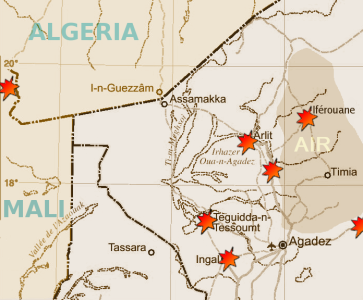
In his speech, Rhissa ag Boula cites an attack on a Niger government military post at Iferwan, in the mountains of the Aïr, north of Agadez (Feb. 7, 2007) claimed by an armed movement, the Niger Movement for Justice (MNJ), which has become increasingly active in the Aïr region over the past year. The initial MNJ attack was followed by a Niger army reprisal on civilians - the army massacred three Tuareg elders at Tezirzait.

The MNJ group says they are fighting because the government refuses to acknowledge the terrible problems facing the Tuareg people, and they have no choice left but to fight in order to get a dialogue going. According to MNJ, the government never followed through with the terms of the Peace Accords created in 1995 to end the last rebellion. Twelve years later, they say, the Tuareg people are still experiencing the same problems of food insecurity, malnutrition, lack of health care, lack of education, unemployment, dire poverty, ethnic discrimination, oppression, and economic and political marginalization, a situation that has persisted throughout the post-colonial era. The government denies this.

The 1995 peace accord guaranteed that the Tuareg people would receive development funds and have greater political representation in Niger (government posts and military appointments). Specifically, 3,160 former combatants would be reintegrated into public services and given economic assistance. Ten years later, in 2005, only 800 former combatants had been integrated into public services, with no sign of significant changes in development, jobs, health care, or education in Tuareg regions. At that point, the United Nations Development Program pulled together $1.8 million dollars donated by France, the United States and Libya: out of $1,8 million dollars, ten years later, the 3,160 former combatants were given $300 apiece in loans to be paid back (not grants), for small projects in animal husbandry, crafts, and gardening.

Most significantly, the MNJ says that foreign business interests exploiting lucrative uranium resources in their region have radioactively polluted their land and water, offer minimal revenues for the country which are appropriated by government officials for private gain, and have not shown concern for the impoverished Tuareg families who live all around the mines by providing development and jobs for the local citizens.

The MNJ points out that Niger just recently received $30 million from China and $33 million from France in anticipation of their uranium exploitation in Tuareg territories, which the Niger President put in a special Priority Investment Fund to be used for the development of health and education facilities, and reduce poverty. Niger has hovered at the very bottom of the United Nations Human Development Index (HDI) for years, and was declared the world's poorest country in 2006 in terms of standard of living and development. The MNJ has questioned the distribution of such revenues, saying that the President and his cronies have pocketed enormous amounts and deposited them in foreign banks or purchased foreign real estate ("capital flight").

In his speech, Ag Boula says that numerous Niger political parties, as well as the Niger National Assembly, have asked the President of Niger to engage in dialogue with the armed movement MNJ. The Tuareg people have also made numerous appeals, but Niger's president has categorically refused to acknowledge the situation, and insists on calling the MNJ "bandits and drug traffickers." Instead, state officials participated in a debate on Niger national television, and made some serious xenophobic accusations against the Tuareg people as an ethnic group, blaming "Tuaregs" for everything that is wrong with Niger.

Rhissa ag Boula publicly condemned their debate on Radio France International, and contacted the officials of numerous countries and international agencies to intervene and help secure peace negotiations. Some of the countries around Niger have tried to approach the Niger government, but the President of Niger refuses to negotiate peace, and continues to send the army into Tuareg territories in the Aïr region to fight the MNJ and murder more civilians in reprisal.

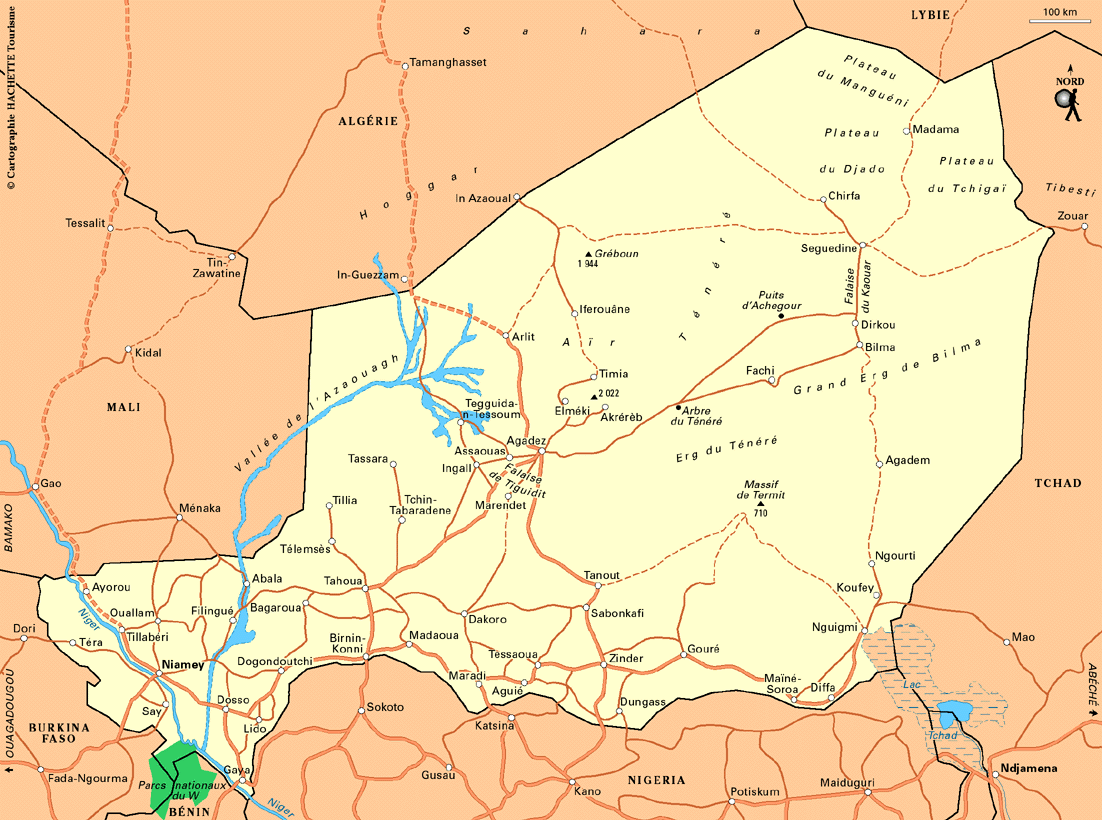
According to Rhissa ag Boula and the MNJ website, to date, several dozen innocent civilians have been massacred by the Niger army: 3 in Tazerzéït, 19 in Touarat, 7 in Gougaram, 22 in Tadara, 2 in Attri, 2 in Agadez, 4 in Chintibzégint, 7 in Téguidit, 1 in Maradi, 1 in Tahoua, and just a few days ago, 4 near the RTA at Arlit. There is also the question of people who were killed by mines at Maradi and Tahoua, which the government attributed to the MNJ [MNJ says the Niger army set the mines]. Also, many innocent people have been arbitrarily arrested and imprisoned.

Rhissa ag Boula is calling for an immediate end to the killing of civilians, an end to the laying of mines, an immediate release of imprisoned innocent civilians, and the government's opening an unconditional dialogue with the MNJ. He says he is convinced that peace is still possible. He is deeply concerned and saddened by what is happening in the North of Niger.

Rhissa ag Boula (1957 -)

Tuareg historian; former freedom-fighter and Niger government official

1990 (Sept. 9) Founding member of UDPS Amana progressive political party in Niger (L'Union pour la Démocratie et le Progrès Social); 29 members total, including Mohamed Agalher (Tchigham), Mano Dayak, Amou Elmoctar, Malfou Akano, Ibrahima Abambacho, Bazo Abambacho, Adam Ibrahim (Alabo), Djibrilla Tougoumane, Hamadi Hato, Aliou Ibrahim

1991-1995 Former leader of the (Niger) Liberation Front of the Aïr and Azawagh (FLAA) and the Organization of Armed Resistance (ORA)

1995 (April 24) Signed the Peace Accords between the government of Niger and the ORA

1997-2004 Minister of Tourism and Artisanry in Niger, following the peace accords requirement to integrate Tuaregs into government positions and military

2000 (October 16-November 6) Tour of the United States to promote American tourist travel in Niger, in his official capacity as Niger's Minister of Tourism and Artisanry

2004 (February) Arrested on suspicion of involvement in the murder of a government official of an opposition political party; he denied it, and is believed innocent by many Nigeriens (Vinding 2005: 437) who feel that his arrest was "designed to provoke the Tuareg into taking up arms so that the government could secure more military and financial aid from the US administration, which had launched its PSI [Pan Sahel Initiative] less than a month previously" (Keenan 2006: 280-281)

2005 (March 4) Released from jail after being held for more than a year without any charges brought against him (Keenan 2006: 280-281, UNHCR March 8, 2006)

2005 (August 28) Elected President of UDPS Amana progressive political party in Niger (L'Union pour la Démocratie et le Progrès Social)

2006 (June 2) President Tandja of Niger consulted Rhissa ag Boula, in his capacity as President of UDPS, to discuss Tuareg problems (Source: Le Republicain)

2007 (December 15) Rhissa ag Boula delivered a speech at a peace rally held in Paris, calling for an end to violence, and negotiations between the freedom fighters and the government


Sources:

HUMACOM
2007 Touaregs; l'Accord de Paix du 24 avril 1995, Niamey, Niger. Published online Oct. 5, 2007 (full text of the Peace Accord) In the original French. In English, translation by Google.

Keenan, Jeremy
2006 Security and Insecurity in North Africa. Review of African Political Economy (ROAPE) No. 108: 269-296. ISSN: 0305-6244

Le Republicaine
2005 Rhissa Boula Recu par le President Tandja. Le Republicain. http://www.republicain-niger.com/ March 24, 2005
2007 Attaque du poste militaire d'Iferouane.
Le Republicain. http://www.republicain-niger.com/ February 15, 2007

Mouvement des Nigeriens pour la Justice (Niger Movement for Justice, MNJ)
2007 http://www.m-n-j.blogspot.com/

Simone, Anne
2007 VouatureSimone CanalBlog.
http://vouaturesimone.canalblog.com/archives/2007/12/17/7270927.html December 17, 2007

Tamazgha
2007 http://www.tamazgha.fr/
2007 http://www.dailymotion.com/Tamazgha_Paris

UN Office for the Coordination of Humanitarian Affairs, IRINNEWS.ORG
2005 Niger: Tuareg ex-combatants to get promised assistance a decade after peace accord. October 14, 2005 http://www.globalsecurity.org/military/library/news/2005/10/mil-051014-irin01.htm

UNHCR - UN Refugee Agency
2006 Respect for Human Rights. http://unhcr.org/home/RSDCOI/4418218914.html March 8, 2006

2007 OCHA/IRIN Niger: Humanitarian Country Profile http://www.irinnews.org/country.aspx?CountryCode=NE&RegionCode=WA

Vinding, Diana
2005 The Indigenous World 2005. IWGIA.
ISBN: 8791563054


Déclaration de Rhissa ag Boula*

Devoir de vérité.

rhissa_aq_boula_1

Le 7 Février 2007, un groupe d'hommes armés a attaqué le poste militaire de l'armée nigérienne à Iférouane, localité située dans le massif montagneux de l'Aïr (nord Agadez), faisant plusieurs morts. Peu après, cette attaque est revendiquée par un mouvement armé dénommé "mouvement des nigériens pour la justice (MNJ)".

C'était le point de départ de ce "mouvement", aujourd'hui très actif dans le massif de l'Aïr (mont Tamagak). Peu après cette revendication, le MNJ a mené des actions armées contre l'armée nigérienne. Celle-ci répliqua en s'emprenant aux civils. Trois vieillards touaregs ont été massacrés par l'armée, ce qui conduisit le MNJ à mener son attaque d'envergure de Tezerzaït au cours de laquelle la compagnie militaire responsable de la mort des trois vieillards a été prise détruite par les rebelles. Face à cette dérive, des personnalités nigériennes, dont moi-même, ont attiré l'attention du gouvernement nigérien sur les risques que la tournure des évènements faisaient prendre au Niger. Les partis politiques, individuellement ou collectivement dans le cadre du Conseil national de Dialogue politique (CNDP) ont sans détour demandé au président de la république d'ouvrir un dialogue avec les insurgés. Puis, l'Assemblée nationale a fait une déclaration dans le même sens, en appelant les autorités nigériennes à engager des pourparlers avec le MNJ.

D'autres déclarations ont suivi, faites par des personnalités touarègues. Celles-ci ont ouvertement demandé au président Tandja d'engager un dialogue avec les responsables du MNJ. Malgré cela, la position du président du Niger et de son gouvernement est restée ferme : refus catégorique de négocier avec des gens considérés comme " bandits et trafiquants de drogue". Plus inquiétant, les autorités de Niamey ont permis à des acteurs de la société civile et à des hautes personnalités parlementaires (députés) d'ouvrir un débat sur les médias d'Etat, notamment à la télévision publique (Télé Sahel). Au cours de ce débat, beaucoup de choses extrêmement graves ont été dites sur les Touaregs. Ainsi, l'ethnie touarègue a été mise au pilori, accusée de tous les maux que connaît le Niger.

Cette médiatisation très grave de la question touarègue nous interpella aussitôt. Ainsi, je me suis personnellement levé contre ces propos xénophobes à l'endroit de la communauté touarègue. Sur RFI, j'ai dénoncé ce débat et la tournure prise, en appelant le président de la république à arrêter rapidement cette escalade et à ouvrir des pourparlers avec les insurgés. Puis, j'ai écris à plusieurs personnalités, africaines et internationales, pour leur demander d'exercer une pression sur le chef de l'Etat afin que celui-ci accepte dans l'intérêt du Niger, de faire la paix avec le mouvement des nigériens pour la justice. Ces personnalités sont: le secrétaire général de l'ONU, la présidente de la commission des nations unies pour les peuples autochtones, le commissaire de l'Union Européenne au développement, les ministres des affaires Etrangères de l'union Européenne ci-dessus: France, Allemagne, Belgique, Danemark, Suède, Norvège, Hollande, Espagne, Italie. J'ai également alerté les ministres des Affaires Etrangères de la Chine, USA, Canada, Australie, etc.

Au niveau du continent africain, j'ai également mis à contibution l'Algérie, le Mali, le Burkina Faso, la Libye, Sénégal, l'Afrique du Sud et le Gabon. Toutes ces personnalités ont, pour certaines, ont effectivement approché le président nigérien pour l'amener à engager le processus de paix avec les insurgés. Cependant, la position du président reste inchangée. Et donnant à l'armée les moyens d'en découdre avec le MNJ, celle-ci s'en prend gravement à la population civile. Ainsi, plusieurs dizaines des personnes innocentes ont été massacrées: 3 à Tazerzéït, 19 à Touarat, 7 à Gougaram, 22 à Tadara, 2 à Attri, 2 à Agadez, 4 à Chintibzégint, 7 à Téguidit, 1 à Maradi, 1 à Tahoua, 4 à RTA. Toutes ces personnes ont été massacrées par l'armée nigérienne. D'autres l'ont également été suite à des actions attribuées au MNJ, en sautant sur des mines à Maradi et à Tahoua. Dernièrement, des opérateurs économiques d'origine arabe ont été massacrés par des militaires nigériens dans le Nord d'Agadez. Dans la foulée, des personnes innocentes ont été arrêtées et incarcérées arbitrairement. Elles croupissent encore dans les prisons du Niger: Koutoukalé, Kollo, Agadez, Say, etc.

Bien entendu, la dérive actuelle a été prévue, et personnellement, je l'ai prévue et c'est pourquoi j'ai fait pression à travers médias et personnalités africaines et internationales pour amener le président à faire la paix en ouvrant un dialogue franc avec les insurgés du MNJ.

Cet appel, je le réitère aujourd'hui à l'endroit du chef de l'Etat et du MNJ. En effet, je lance un appel pressant pour:
1/ un arrêt immédiat des tuerries des civils
2/ un arrêt immédiat de la pose des mines
3/ Une libération immédiate des personnes civiles et innocentes détenues
4/ Une ouverture sans conditions du dialogue avec les insurgés.

Je demeure convaincu que la paix entre frères nigériens est toujours possible.
Toutefois, en tant que porteur de légitimité historique par rapport à la question touarègue, je me sens vivement interpellé par ce qui se passe dans la zone nord de mon pays. Aussi, suis-je fortement blessé par ce qui se passe dans cette zone.

Rhissa Ag Boula*

*ancien ministre du Tourisme
et figure de proue de l’ex-rébellion touarègue.

Source:

Simone, Anne
2007 VouatureSimone CanalBlog.
http://vouaturesimone.canalblog.com/archives/2007/12/17/7270927.html December 17, 2007

December 09, 2007

Issouf ag Maha's visit to the United States

Tuareg leader and author, Issouf ag Maha, recently visited the United States on a three week tour to deliver a series of speeches and interviews concerning the crisis in Niger, and the difficulties faced by the Tuareg people.

Oct. 27, 2007 "Struggling Around Climate Change." Global Problems, Global Solutions Forum, La Roche College, Pittsburgh, PA

Oct. 30, 2007 "Niger: Crises and Opportunities." Longwood University, Farmwood, VA. Two history professors there, Dr. Steven Isaac and Dr. Geoffroy de Laforcade, along with 20 students, had conducted a university course in Niger in Jan. 2007 that was hosted by ag Maha.

Nov. 13, 2007 WBAI Radio interview with Bill Weinberg, New York City. He discussed the threats to the Tuareg nomadic way of life, including desertification and global warming; the effects of uranium mining and militarism on the population; the music of exile and struggle; and the roots of the new Mouvement des Nigeriens pour la Justice (MNJ, Niger Movement for Justice).


Photo Credit: Zonta International. Right to left, Peggy Schmiedecke - Golden Z Chair, La Roche student, Issouf ag Maha - Mayor Tchirozenrine, Niger, Nancy Crouthamel - Club President, Geoffrey de Laforcade - Connecticut Wesleyan University; participants in the La Roche College "Global Problems, Global Solutions Forum."


Issouf ag Maha

Author, Touareg du XXIe siècle ['Tuareg of the 21st Century']

Mayor of Tchighozerine, Niger

Agronomist, specializing in development and environmental issues

Community leader and social activist, involved in humanitarian efforts

Head of Agharous Voyages, tourism agency that organizes travel for Croqu'nature and Atalante

Organizer of the Association pour le Développement Durable et la Solidarité (ADDS) and Tchinaghen, Paix et Solidarite pour le Nord Niger.

Email: tchinaghen@yahoo.fr

Recent interview with Issouf ag Maha:

"Bravo for France, Congratulations to Areva, Too Bad for the Tuaregs"

Issouf ag Maha discusses the socio-political and environmental difficulties presented by mining interests at Arlit [in the Aïr region north of Agadez], including 122 contracts the Niger government has awarded to several countries, particularly France and China, to exploit the uranium in Tuareg territories. Meanwhile, "The nomad population in this region was forced to leave for other lands. Wildlife has completely disappeared. The aquifers are [radioactively] polluted. The population is facing serious public health problems." The government denies that these problems exist, and refuses to discuss them with the Tuareg people. "The Tuaregs have no choice but to fight or disappear. . . . The Nigerian army, which has material support from France, China and the United States, has launched an offensive on the Aïr to reduce us to silence." Video of interview and transcription is online:

(In French, with video interview of Issouf ag Maha)

(In English)


Issouf ag Maha's recent book (Feb. 16, 2006)

Touareg du XXIe siècle ['Tuareg of the 21st Century']:

France: Grandvaux. 195 pages. ISBN-10: 2909550443

Amazon.com

Issouf ag Maha shares his experiences and reflections on the Tuareg generation born in the 1960s, caught up in forced schooling, terrible droughts of the 1970s and 1980s, rebellions of the 1990s, and numerous coup d'etats. The world views the Tuaregs as an exotic people, but ag Maha sees the situation in practical terms, struggling with the challenges of herding in the face of global warming and seeking sustainable development for his people.

More photographs of Issouf ag Maha online:

La Roche College

DesertRebel

Mairie16

MNJ Blog

December 07, 2007

Welcome to Tuareg Culture and News!

The purpose of this blog is to offer educational links and sources for the study of Tuareg culture, to English-speakers including students, researchers and others interested in learning about the Tuareg people. The Tuareg people are not simply an exotic culture in a remote part of the world - they are real human beings with families, and right now they are facing some very serious problems. While the Tuareg people may be known to some Americans as the source of some nifty silver jewelry that's being sold by entrepreneurs on Ebay and private websites, our website seeks to educate Americans about the realities of environmental, economic, and political problems that Tuareg families are having to deal with today. The Tuareg are real people with values, needs, joys and sorrows - and they are suffering a terrible humanitarian crisis at this moment.