May 02, 2020
CORONAVIRUS: UTTER DISASTER LOOMS AROUND THE GREAT SAHARA (SAHEL)
Posted by
Tanat
at
10:19 PM
August 01, 2016
Northern Mali's Schools in Ruins
Three Tuareg children stand in the ruins of their little school building
in northern Mali. The conflict there continues, despite a peace accord
last summer. The board in back is their chalkboard. Many Tuaregs
remain in refugee camps outside of Mali because state-supported militias
keep attacking Tuareg civilians.
Posted by
Tanat
at
10:24 AM
June 28, 2016
Torrential Rains Ravage Northern Niger
MondAfrique
Des inondations ravagent le nord du Niger
Par Mohamed Ag Ahmedou -
26 juin 2016
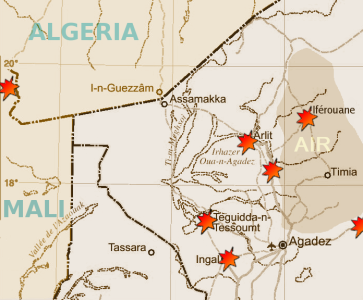
Des pluies diluviennes créent une catastrophe humanitaire dans le département d’Ingal au nord du Niger. “La population de la région est fragilisée par les inondations qui ont causé d’énormes dégâts” a déclaré Aghali Etay Kelfedy membre du comité d’appui de la municipalité d’Ingal. Les populations sahéliennes sont plus que jamais touchées par des problèmes de changements climatiques.
Le bilan est alarmant :
-- 644 ménages sinistrés [644 affected households]
-- 4,204 personnes sans abris [4,204 people HOMELESS]
-- 161 maisons effondrées [161 banco houses collapsed]
-- 08 cases emportées [8 huts swept away]
-- 318 bovins morts [318 cattle dead]
-- 11,012 ovins morts [11,012 sheep dead]
-- 10,654 caprins morts [10,654 goats dead]
-- 227 arsins morts [227 donkeys dead]
-- 44 camelins morts [44 camels dead]
-- 98 puits effondrées [98 water wells collapsed]
-- 116 jardins de 26.2 hectares détruits [116 vegetable gardens, 26.2 hectares, destroyed]
En tout, 79%, de la province d’Ingal est touchée par les inondations.
Le Sahel, victime du changement climatique
Les cadres de la mairie interpellent désormais le gouvernement nigérien et ses partenaires sur le risque de propagation des maladies transmissibles via l’eau dans laquelle gisent des cadavres d’animaux en décomposition. “Le risque des maladies peut venir de la seule eau consommable qui est disponible dans la province à savoir celle des marigots. Des mesures doivent être prises le plus vite possible pour éviter le pire,” interpelle Aghali.
Les populations se trouvent dans une situation extrêmement difficile suite à la catastrophe qu’elles ont connu à travers ces inondations. Beaucoup de femmes et d’enfants sont condamnés à dormir dans les rues ou les écoles à cause de la destruction de leurs domiciles emportés par les eaux. Selon le cadre de la mairie d’Ingal un comité de crise constitué de huit personnes de la municipalité plus un membre du cabinet du premier ministre a été mis en place pour évaluer la situation.
Depuis quelques années plusieurs dizaines de personnes périssent dans le desert nigérien très touché par les changements climatiques. De nombreux experts africains attirent l’attention sur l’urgence à créer un fond dédié aux catastrophes causées par le réchauffement de la planète dans le Sahel. Pour les tenants de cette initiative, les grands pollueurs au niveau mondial devraient contribuer à alimenter ce fonds à 90 %.
http://www.mondafrique.com/inondations-ravagent-nord-niger/
Posted by
Tanat
at
5:05 PM
Freak rainstorms wreak havoc in Niger desert
Report from Agence France-Presse
Published on 20 Jun 2016
Niamey, Niger | AFP | Monday 6/20/2016 - 12:48 GMT
Unusually heavy rains in Niger's desert north in recent days have killed thousands of goats and cattle, gutted homes and stores, and left three people dead, national television said Monday.
"Torrential rains caused severe damage and three dead in Bazagor", a town in the northwestern province of Tchintabaradene, and destroyed 100 stores and 100 homes, said Tele Sahel.
In Ingal, near the northern city of Agadez, "85 millimetres (3 inches) of rain fell in two hours" on June 14, though yearly rainfall is rarely over 100 to 130 millimetres there.
Hundreds of people have been left homeless in the past days with more than 8,000 goats, sheep, cattle and camel killed in the area, where animal corpses are visible over 20 kilometres, television footage showed.
Sub-Saharan Niger, a vast arid nation, regularly suffers food shortages due to drought.
But early this month the UN warned of floods in 2016 affecting the livelihoods of more than 100,000 people.
Climate change has wrought havoc in Niger, bringing floods, droughts, spikes in temperature and food shortages -- buffeting the lives and livelihoods of millions of the country's farmers.
Flooding in 2012 killed more than 100 people, affected more than half a million Nigeriens and caused at least 135 million euros ($145 million) worth of damage, according to the disaster prevention office.
Floods similarly killed dozens of people and affected hundreds of thousands in 2014 and 2015.
Global warming is only worsening the problems, with the steadily encroaching desert now covering three-quarters of Niger.
hb/kc/ccr/ric
© 1994-2016 Agence France-Presse
http://reliefweb.int/report/niger/freak-rainstorms-wreak-havoc-niger-desert
Posted by
Tanat
at
4:32 PM
Three Dead, Thousands of Tuareg Livestock Perished, Unusual Torrential Rain
Unusual torrential rain in Niger desert kills 3
Ismail Akwei with AFP 20/06 - 15:12
At least three people died and thousands of livestock destroyed after heavy torrential rain in the desert in northern Niger.
Nigerien state television, Tele Sahel, which announced the death toll on Monday described the rain as exceptional adding that it destroyed hundreds of shops and houses.
“Heavy rainfall caused significant damage killing three people in Bazagor, a locality of Tchintabaradene in the northwest,” they announced adding that more than 115 millimeters of rain fell within hours.
On June 14, Ingal, a town hundred kilometers from Agadez in the north, 85 millimeters of rain fell in two hours rendering thousands homeless as it collapsed hundreds of houses, according to local disaster management services.
The waters also killed more than 8,000 goats, sheep and cows prompting the prefect of the town, Abdourahamane Bikki to appeal to the government and international aid for help and the cremation of animal carcasses to prevent serious health problems.
The havoc created by the heavy rain in Niger adds to the number of damages recorded in the west coast of Africa including Ghana and Nigeria where flooding affected major parts of their capital cities.
http://www.africanews.com/2016/06/20/unusual-torrential-rain-in-niger-desert-kills-3/
Posted by
Tanat
at
4:23 PM
Thousands of Tuareg Livestock Destroyed after Two Hours of Torrential Rains in Northern Niger
Tuesday, 21 June 2016
A months rain in a couple of hours kills 3 and thousands of livestock in Niger: The latest West African country to be devasted by floods
At least three people died and thousands of livestock destroyed after heavy torrential rain in the desert in northern Niger.
Nigerien state television, Tele Sahel, which announced the death toll on Monday described the rain as exceptional adding that it destroyed hundreds of shops and houses.
"Heavy rainfall caused significant damage killing three people in Bazagor, a locality of Tchintabaradene in the northwest," they announced adding that more than 115 millimeters of rain fell within hours.
On June 14, Ingal, a town hundred kilometers from Agadez in the north, 85 millimeters of rain fell in two hours rendering thousands homeless as it collapsed hundreds of houses, according to local disaster management services.
The waters also killed more than 8,000 goats, sheep and cows prompting the prefect of the town, Abdourahamane Bikki to appeal to the government and international aid for help and the cremation of animal carcasses to prevent serious health problems.
The havoc created by the heavy rain in Niger adds to the number of damages recorded in the west coast of Africa including Ghana and Nigeria where flooding affected major parts of their capital cities.
http://www.thebigwobble.org/2016/06/a-months-rain-in-couple-of-hours-kills.html
Posted by
Tanat
at
4:18 PM
Flooding in Northern Niger Destroys Tuareg Livestock
Freak rainstorms wreak havoc in Niger desert
AFP Wired World 20 Jun 2016 02:54 (South Africa)
Unusually
heavy rains in Niger's desert north in recent days have killed
thousands of goats and cattle, gutted homes and stores, and left three
people dead, national television said Monday. "Torrential rains
caused severe damage and three dead in Bazagor", a town in the
northwestern province of Tchintabaradene, and destroyed 100 stores and
100 homes, said Tele Sahel. In Ingal, near the northern city of
Agadez, "85 millimetres (3 inches) of rain fell in two hours" on June
14, though yearly rainfall is rarely over 100 to 130 millimetres there.
Hundreds
of people have been left homeless in the past days with more than 8,000
goats, sheep, cattle and camel killed in the area, where animal corpses
are visible over 20 kilometres, television footage showed. Sub-Saharan Niger, a vast arid nation, regularly suffers food shortages due to drought.
But early this month the UN warned of floods in 2016 affecting the livelihoods of more than 100,000 people. Climate
change has wrought havoc in Niger, bringing floods, droughts, spikes in
temperature and food shortages -- buffeting the lives and livelihoods
of millions of the country's farmers.
Flooding in 2012 killed more
than 100 people, affected more than half a million Nigeriens and caused
at least 135 million euros ($145 million) worth of damage, according to
the disaster prevention office. Floods similarly killed dozens of people and affected hundreds of thousands in 2014 and 2015. Global warming is only worsening the problems, with the steadily encroaching desert now covering three-quarters of Niger.
hb/kc/ccr/ric
© 1994-2016 Agence France-Presse AFP Wired World
http://www.dailymaverick.co.za/article/2016-06-20-freak-rainstorms-wreak-havoc-in-niger-desert/#.V3LYTo5RnE8
Posted by
Tanat
at
4:12 PM
June 26, 2016
Please make a contribution to help Tuareg families in Niger
Flash floods earlier this month in Niger have destroyed Tuaregs' livestock. Please click on the link to make a contribution - any amount is welcome. All funds will go to Sidi Mahmane, the Mayor of In Gall (west of Agadez) in northern Niger to be distributed to these families to help them recover. Thank you for your support!
Click here for fund-raising website to make a contribution
Posted by
Tanat
at
3:39 PM
May 20, 2014
Azawad Women's Association, Open Letter to the United Nations
Main points:
-->
Dans le cadre d’une mission des Nations Unis, vous êtes appelé au chevet du Mali, en crise, de par la faute de ses dirigeants politiques pour essayer de trouver une solution politique au problème qui oppose l’Azawad au pouvoir central du Mali. Leurs parodies de démocratie et de bonne gouvernance sont aujourd’hui mises à nu. Ils ont été incapables, en cinquante quatre ans, de construire une nation plurielle.
En tant que représentant d’une organisation internationale neutre nous attendons de vous une prise en considération de toutes les conséquences de cette crise en toute impartialité. Aujourd’hui a notre grande surprise nous entendons votre communiqué du 18 Mai 2014 basé sur les accusations infondées des pouvoirs maliens taxant les mouvements de l’Azawad de procéder a des assassinats et prises d’otages lorsqu'il y a eu un affrontement entre deux parties armées et que l’une a pris le dessus sur l’autre.
Nous attendons de vous en tant que représentant de la plus grande organisation au monde qui s’érige en défenseur et garant des droits humains un minimum de neutralité pour une prise en compte des crimes commis contre les populations civiles de l’Azawad même si cela déplairait sans doute a Bamako car c’est votre mission et le devoir qui vous incombe lorsque vous avez choisi de servir cette noble cause au sein des nations unis.
Dans l’état actuel de délabrement de l’Etat malien, ses dirigeants en manque de réelle volonté de paix et leur armée raciste sont enclins à utiliser l’Azawad comme un terrain d’expérimentation pour tester les performances d’une armée en dérive sur des
populations sans défense. Vous prenant à témoin, nous voudrions leur faire observer que le défi n’est pas de "reconquérir kidal occupé par ses propres populations" ou de veiller jalousement sur le résultat du dépeçage colonial, mais de renouveler le vouloir vivre ensemble, sur des bases saines. Cette volonté de vivre ensemble est l’essence de la nation ; elle est reconnaissance des différences, en vue de les transcender.
Ce Mali que la communauté internationale défend bec et ongles il est important de ne pas occulter que si son origine dérive d’une volonté absolue d’un colonisateur qui a découpé le territoire selon son gré sans l’aval d’aucune des populations qui se sont retrouvées dedans. Son maintien de nos jours relève inévitablement d’un contrat social issu des différentes communautés le composant sur la base des principes fondamentaux tels que: le principe de bonne gouvernance: le respect des droits humains, l’autogestion et, la reconnaissance des génocides répétés commis à l’encontre des populations civiles blanches.
Nous souhaitons une réussite a votre mission de paix car nous sommes les premières victimes de cette guerre et nous seront les bénéficiaires de la paix c’est pourquoi , nous avons toujours réclamé le dialogue mais les autorités maliennes s’avèrent
incapables de sagesse parce que dans le registre de la ruse, les personnes en charge du dossier n’ont répondu que par des manœuvres de division, l’envoi de forces militaires, les pogroms et les exactions de toutes sortes.
Notre message est clair:
Le peuple de l’Azawad ne fera l’économie d’aucun sacrifice pour atteindre ses aspirations légitimes. Seul un dialogue sincère et respectueux, fondé sur une conscience collective de la nécessité de la paix et de la justice, permettra d’épargner à nos peuples les affres d’une guerre de faibles. Un tel dialogue requiert humilité et lucidité.
Le peuple malien a connu d’autres difficultés très graves (coups d’Etats, révoltes autres que celles des Azawadiens, etc.). A ces occasions, nous n’avons pas assisté à un rejet des revendications, mais plutôt, la prudence, le dialogue et l’écoute ont été mis en avant pour les résoudre, car le sentiment qu’il s’agit d’une partie de la nation meurtrie et déchirée a prévalu. Nous sommes fortement convaincues que si le problème de l’Azawad était considéré de la même manière, sa résolution n’en sera que plus rapide.
Nous voudrions rappeler ici que des groupes terroristes et de narcotrafiquants écument la bande saharo-sahélienne depuis plus d’une décennie, sous le regard impuissant, indifférent, indulgent ou complice des Etats de cette région. Ils constituent une menace gravissime pour l’Azawad. Les Azawadiens ne sont ni intégristes ni trafiquants pas plus que tous les autres peuples du monde tous présents au sein de cet nébuleuse terroriste : nous lutterons de toutes nos forces contre ce danger.
Nous vous adressons cette lettre pour attirer votre attention sur le regard que nous portons sur vous et votre organisation connaissant votre attachement à la paix, vous nous permettrez, Excellence, d’associer pleinement, toute la communauté internationale, à notre appel aux dirigeants maliens: les voiles sont tombés et plus rien n’empêche, dans le cadre d’un dialogue construit, de reconnaître le calvaire que le peuple de l’Azawad endure depuis plus de trois générations, de reconnaître son aspiration à la liberté et la dignité, de croire en sa capacité d’être responsable de son destin, de vivre en paix avec tous ses voisins.
Excellence, le représentant des nations Unis,
Les pays, c’est aussi les peuples, la finalité, d’où les États tirent leur légitimité. Ils doivent être écoutés, au-delà de leurs États. Plus des centaines d’Azawadiens sont réfugiés dans les pays voisins, fuyant les exactions de l’armée et des milices maliennes qui n’ont jamais cessé et qui ont déjà emporté des milliers de femmes, d’hommes, de vieillards, d’enfants, qui n’ont eu le tort que vouloir vivre en paix sur leurs terres. Soutenir un Etat sans conditions dont les dirigeants sont d’une telle petitesse d’esprit n’est pas porteur de paix durable.
Veuillez agréer, Excellence Monsieur Le Représentant des Nations Unis au Mali, l’expression de notre plus haute considération.
Assi walet Hitta
Posted by
Tanat
at
1:11 PM
June 10, 2013
New book, by Tuareg author Ahmed Kemil
Ahmed Kemil, a young Tuareg man from northern Niger, has written a deeply personal and sensuous account of growing up as a camel herder in the Sahara. The book is written in English, which will be much appreciated by those who do not read French, since much of the literature on Tuaregs is in French. He writes about the practical concerns of nomads caring for their precious livestock. Tuareg nomads love their camels, and the camels also love their Tuaregs; they are like members of the family. Each camel has a history and a name. Ahmed gives us very detailed insights into the concerns of pastoralists, their ongoing quest for water and pasture, and their understanding of the harsh terrain and the erratic weather. He talks about his joys and his fears, including his experiences in a bush school, dealing with extreme thirst and pain, the ravages of flooding and drought, and his tragic accident at the age of seven. He also talks about the connectivity between camps of nomads, information sharing, and their community interdependency and reciprocity that enables them to survive. The book is filled with personal stories of Ahmed’s life as a nomad, including the second part of the book where he makes comparisons with his experiences in the U.S.
-- Dr. Barbara A. Worley, Department of Anthropology, University of Massachusetts, Boston
Everyone
interested in the Tuareg people should consider buying a copy of this book!
Available on Amazon.com as a Kindle edition (you can read it on your
computer or iPhone).
Readers
do NOT need a Kindle device in order to read a "Kindle" edition - when
you buy it, you will see that there are different options for reading
it, whether on a Kindle device, your computer, or the Amazon "Cloud."
It's easy!
Posted by
Tanat
at
11:06 AM
April 14, 2013
Tuareg Refugees Speak Out
Thousands of Tuareg people have been demonstrating at the Mbera refugee camp in Mauretania, where they fled from the armed conflict in Mali, the racialized hatred, and the atrocities of the Malian army. It has been really hard for them to survive in the Mbera refugee camp, because there is not enough shelter and food for everyone, and the children cannot go to school.
Bamako recently sent representatives to tell the refugees to go back to Mali so they can vote. But the refugees have refused for two reasons: (1) there have been ongoing arrests, torture, and killings by the Malian army of innocent Tuareg civilians, and (2) the elections are not fair - for years, now they have been hijacked by government officials who are in cahoots with the narco-traffickers and jihadists. They also pay people to vote for their candidates. The Tuaregs want democracy and fairness.
The refugees are speaking out about the injustices going back fifty years, and the crimes of the Malian government and army against their relatives and ancestors.
The two boys in the video are asking, "Why is Mali killing our people?" and "Why are Europeans and Arabs and other people free, but not the Tuaregs? Why are we treated differently?" They are saying, "The Kel Tamasheq want freedom and dignity!"
~ ~ ~ ~ ~ ~ ~ ~ ~ ~ ~ ~ ~ ~ ~ ~ ~
.
Posted by
Tanat
at
7:58 PM
Population Estimates for Tuaregs
Source: Keenan, Jeremy, 2004. Introduction: Indigenous Rights and a Future Politic amongst Algeria’s Tuareg after Forty Years of Independence. IN: The Lesser Gods of the Sahara. London: Frank Cass. pp. 1-3
Niger: 1.4 million
Mali: 1.5 million
Algeria: 590,000
Burkina Faso: 160,000
Libya: 190,000
Chad: 110.000
Mali = 1,440,000 (1991)
Algeria = 1,025,000 (1987)
Burkina Faso = 600,000 (1991)
Posted by
Tanat
at
3:40 PM
March 01, 2013
Anti-Tuareg Propaganda: Cease and Desist
I just posted the following on Bruce Whitehouse's blog article. The propaganda war against the Tuareg people is being fought by people who do not even know them - including the writer of the blog article, who is an anthropologist.
Bruce
Whitehouse, you should be ashamed of yourself. You are no expert on the
Tuaregs to be saying such misleading and damaging things about them, and
you have grossly violated the anthropological code of ethics. No one
should take anything you say seriously because it is clear that you have
a lethal axe to grind on the Tuareg people, without any authority
whatsoever.
The American Anthropological Association (AAA) Code
of Ethics says anthropologists have an obligation toward vulnerable
populations, to carefully weigh the consequences of what they claim
about them. Your statements about the Tuareg people demonstrate your
partisan bias against them, at a time when people of Tuareg identity are
at high risk for genocidal attacks, in a very sensitive geopolitical
situation that is dangerously impacting them. You are in flagrant
default of the AAA Code of Ethics and you should be ashamed of yourself
for making claims and arguments that are damaging to the Tuareg people.
You owe an apology to the hundreds of thousands of Tuareg people that
you have disrespected at a time when they are fleeing racialized hatred
and genocidal attacks. Your words have added to the propaganda and
hatred against the Tuareg people.
For you to say that In Kati,
the burning of Tuareg homes wasn’t discrimination, it was “a
misunderstanding” is a gross misrepresentation of what happened at Kati.
The streets filled with mobs of people screaming “Death to the
Tuaregs!” The Tuareg people were chased, robbed, and had their homes
burned, and hundreds of thousands of Tuareg people have fled the
visceral hatred and horrific abuses against them in Mali. A year later,
they are still refugees, having lost their homes and livelihoods. What
happened at Kati is emblematic of the abuses and atrocities that Tuareg
people have suffered for the past 53 years. Your attempt to softpedal
the ethnic hatred that has motivated the government of Bamako and people
in the south is insulting and damaging to the Tuareg people. In
soft-pedaling the ethnic hatred, you are showing your support for it.
You have tried to shut up the Tuaregs who have posted on your blog,
telling them (in French) to keep their opinions to themselves, while at
the same time blathering your own racist opinions against the Tuareg
people. Tuareg voices have been shut up for much too long. They are
indeed “coming out of the woodwork” – your choice of words, a pejorative
usage for disgusting things like bugs that “come out of the woodwork.”
Your words constitute propaganda against the Tuareg people, and your
attempts to shut them up are utterly disgraceful for an anthropologist.
The Tuaregs are not bugs, and they are beginning to have their voices
heard by speaking out against unjust propagandists such as yourself. You
insulted one Tuareg who attempted to write in imperfect English, and
claimed you could not understand him – but it is plenty clear that the
Tuareg writer is bringing his own argument to bear on your damaging
words.
It’s true that you are “no expert on the Tuareg,” and
you should not be making arguments against them. You are unable to bring
clarity to the problems facing the Tuareg people, and you have no
authority whatsoever to be making the claims you are making against
them. As an anthropologist, you have exceeded the limit of ethnocentrism
and you are actively promoting perspectives that are damaging to a
vulnerable ethnic group that you do not even know well enough to discuss
responsibly.
-- Barbara A. Worley, Ph.D. (Columbia University) - Anthropologist and Tuareg specialist for forty years
Posted by
Tanat
at
8:02 AM
February 20, 2013
Playing the "Slavery Card"
© Copyright Barbara A. Worley 2013
[2] http://tuaregcultureandnews.blogspot.com/2012_07_30_archive.html
Posted by
Tanat
at
8:29 PM