March 07, 2010

Call for National Dialogue, Issues of the North in Niger

Attayoub Abdoulahi, who is President of the organization Temoust (Tuareg Cultural Survival), and is a Tuareg from Niger, has written a new editorial in French (March 1, 2010) concerning the recent coup d’état in the Republic of Niger. What follows is a summary.

CLICK HERE FOR ORIGINAL EDITORIAL IN FRENCH

The elimination of Tandja as the country’s president does not mean that democracy is being “restored,” since there has never been a true democracy in Niger. Force is not necessarily the best way to overcome the shortcomings of the political leadership. The coup may produce more problems than it can solve, since it reinforces the widespread belief that change can not happen through democratic channels.

What Niger needs is an understanding of the root cause of the country’s instability, and the fact that the political elites have not been capable of establishing rules of governance that are shared by the entire population – rules that could be defended against any potential usurper.

The only way that the current political class will stop wallowing in its contradictions, keeping the country in a state of chronic instability, is if the transition government acts from an enlightened and patriotic perspective, through a major overhaul of the Republic.

Much depends on the personality of the new head of state, who must realize that he will be taking on a challenge with history. His credibility will be measured by his capacity to shed the image of a facilitator in the service of a clan, and demonstrate that he is acting in the interest of the entire country, and all of its peoples.

Genuine political reform would involve a redistribution of the cards, and a renewal of the political class – not just tossing the word “democracy” around, but making the effort to define what we mean by democracy, creating rules of governance such that every Nigerien will feel represented and protected by the country’s institutions.

Without a sustainable, quality foundation that is resistant to the vagaries of cyclical policies, we are just “making braids on top of lice,” (alataf fel chilken), as the Tuareg saying goes. Nigeriens need to see the country moving toward a better tomorrow.

The struggle against institutionalized corruption is a priority at all levels of government. Justice must find a way to end the culture of impunity. One’s membership in a sociocultural group must not be a handicap, nor a springboard for personal success.

We do not feel that the transition government should be hurried toward elections. We are once again at a crossroads that might lead toward a better tomorrow, but the worst is always possible.

We need time to conduct a broad national consultation, whose findings could be used to draft a new constitution. We need a broad national dialogue, debates without taboos or fallout.

This must address the issue of the North in a spirit of reconciliation and nation building. A working group could undertake to do an inventory on issues of the North, and propose areas to be discussed at a national forum.

A definitive resolution of issues of the North is all the more urgent, since the geopolitical context is becoming increasingly threatening. Niger cannot afford to maintain internal bickering that exposes the country to all sorts of impulses.

February 24, 2010

New book, by Tuareg author Mohamed Ahamok


Image may not be used without permission
of Mohamed Ahamok, copyright 2008

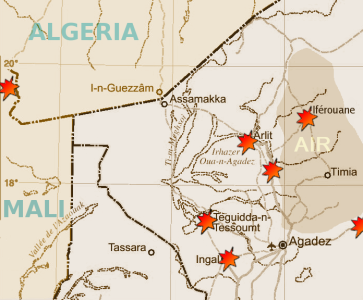
Mohamed Ahamok, a Tuareg author from the In Gall region of northern Niger, has published a new book in English, Tuareg Short Stories.

In this book, Mohamed recounts stories told in his family's nomad camp in the In Gall region of Niger. Some of the stories are traditional tales, and others are stories fashioned by Tuareg storytellers.

Many stories center about the animals found in the Sahara and Sahel -- camels, lions and hyenas. There are stories of beautiful women and kings. Some are moral tales ending in a proverb. You won't want to miss the surprise endings, characteristic of the Tuaregs' unique sense of wit and humor!

The book is an excellent addition to any Tuareg literature collection, and is suitable for children, as well.

The first few pages of the book may be previewed online, and the book may be purchased HERE:

Price $24.95

(Copyright Mohamed Ahamok 2008)


June 05, 2009

Recent Progress Toward Peace in Niger


Evolution of Tuareg-led Rebel Groups in Niger:

MNJ created in February 2007, includes Aghali ag Alambo (Pres.) - largest group
FFR created in May 2008, included some MNJ leaders, Aoutchiki Kriska (Pres.) and Rhissa ag Boula
FPN created in March 2009, included some MNJ leaders and Aklou Sidi Sidi (Pres.)

RECENT PROGRESS TOWARD PEACE IN NIGER:

In Sum: A ceasefire was agreed May 15, 2009. For the moment there is no violence. However, the president has reinstated the "state of emergency," continuing the police and army's sweeping powers over people in the North, and there is no formal plan to discuss and negotiate the claims that motivated the rebellion in the first place. 20,000 displaced people (mainly Tuareg) need to go home and rebuild their communities and find food to eat, but it's not clear whether the president's ban on humanitarian aid and travel into the North has been lifted to permit the UN and other agencies access. High-level government corruption and lucrative revenues from the uranium and oil contracts may have led to a stand-off between the president and his party, and most of the rest of the country. The president has dissolved parliament, seen by some as a political coup d'etat, and wishes to revise the constitution so that he and his party may remain in power for a third term. Some fear corruption may enable him to achieve that goal. If that happens, Niger will likely descend into a further state of instability. Human rights activists say they will defend democracy, and the rebels may balk on laying down arms if the government is not responsive to the needs for which they have been fighting. Democracy is at stake, as well as the stability of one of the worlds' poorest countries.


April 3, 2009: Peace talks took place in Libya, between Niger’s Minister of the Interior, the MNJ and FPN. FPN issued congratulations to Niger’s President Tandja Mamadou for making this gesture toward peace (RFI April 4, 2009).

April 15, 2009: The Niger government released a statement assuring the state’s desire for peace. Meetings continued, with all three rebel groups. FPN continued to release affirmative statements, but MNJ was still holding one Niger army officer, alleged to have committed atrocities (Le Sahel April 15, 2009).

April 28, 2009: United Nations World Food Programme announced it would provide food and resettlement centers to repatriate 20,000 people (principally Tuareg) displaced during the rebellion since 2007 (PANA April 28, 2009). Many structures had been destroyed; medical clinics and schools had been closed; and food supplies had been cut off due to the conflict and the “state of emergency” which restricted the flow of goods and people in the North, and gives the Army sweeping powers to arrest and detain people, maintain a strict curfew, and disperse public gatherings. Humanitarian aid to the North had been banned by President Tandja Mamadou starting in 2007; food, medical care, and basic necessities had become very difficult to obtain in the North because of the travel restrictions and government bans. Very few attempted to return to their homes.

May 3, 2009: MNJ released its last prisoner. Niger’s President Tandja Mamadou visited Agadez in the conflicted North of Niger, to lay the cornerstone for a new French Areva uranium mine at Imouraren. He also met with rebel groups, asking them to put down their weapons, saying he forgave them, and would permit amnesty. The process of turning in weapons has begun, but FFR said it would be a long process. Tuareg rebel leaders said that Niger's president must lift the "state of emergency" in the North as a precondition for "formal in-depth negotiations" (AFP May 23, 2009).

May 13, 2009: MNJ said it would not disarm, unless Niger's government is willing to first negotiate on its demands [which are published on the MNJ website] (AFP May 12, 1009).

May 15, 2009: Ceasefire agreement reached after talks between MNJ, FPN and Niger's Prime Minister Seyni Oumarou, backed by the Libyan government (Afrol News May 15, 2009) . The FFR boycotted the talks (BBC May 15, 2009).

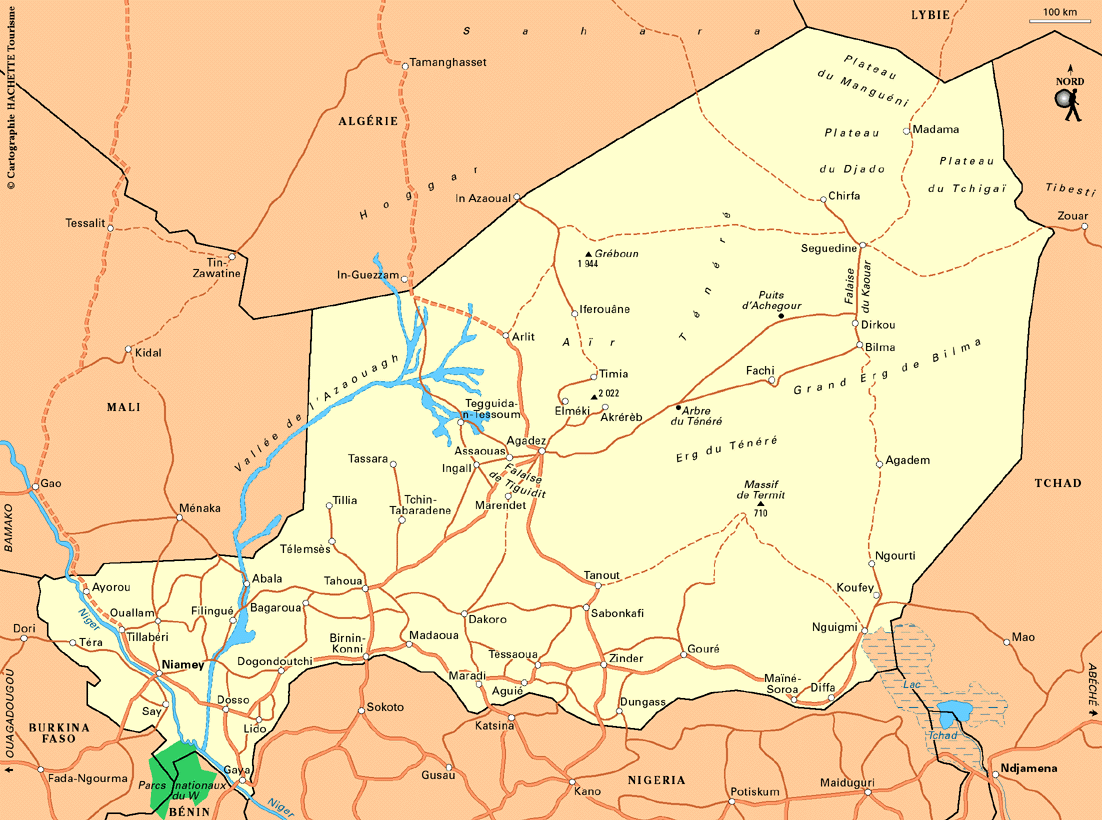
May 23, 2009: Government of Niger renewed the “state of emergency” in the North for 3 more months, to permit continued police and military vigilance and detention of suspects, and a continued ban on public gatherings (AFP May 23, 2009). It is not clear whether the UN has been able to get any food and supplies to the repatriation zone in the Iférouane, Gougaram, Djanet, Dabaga et Tchirozérine districts of the Department of Agadez.

May 26, 2009: President Tandja Mamadou dissolved Niger's parliament, a day after the constitutional court said his bid to extend his presidency another term was unconstitutional (VOA June 2, 2009). Tandja has already served two 5-year terms. A new parliament must be formed within 3 months. Tandja's decision has global uranium and oil investors worried, and they are delaying their projects in Niger (Reuters May 27, 2009). Michael Keating at World Politics Review says the world should be paying more attention: Niger, an unstable state, is a major producer of uranium (UN Dispatch May 27, 2009). Some 20,000 people demonstrated in the streets of Niger's capitol, Niamey, and across the country (Reuters May 26, 2009). The African Assembly for the Defense of Human Rights suggests that Tandja's move "looks like a political coup d'état" (Aljazeera May 26, 2009).

June 1, 2009: Niger's President Tandja Mamadou is pursuing his bid to change the country's constitution, so that he may remain in power for another term (Reuters June 1, 2009). Many in Niger are opposed to Tandja staying in power, not just the opposition parties, but also many who had previously been his supporters, including the Alliance for Democracy and Progress party, which said it would "Create a grave threat to peace and stability" (VOA May 29, 2009). ECOWAS has threatened economic sanctions if Tandja pursues an extended presidency. The U.S. government said it would be a "setback for democracy." France, which has major uranium interests in Niger, will be put to the test: France wants to double its uranium production by 2015 (ISN Security Watch May 19, 2009). Two years ago, Niger ended France's monopoly over uranium mining, and quickly began awarding some 140 uranium concessions to numerous global companies, putting France in competition with a number of world players. Moreover, uncertainty over the political situation is likely to result in serious difficulties with the Tuareg peace process. The enormous increase in uranium and oil income [resulting in huge "signature bonuses" paid to the president] may be a significant factor in Tandja's desire to prolong his presidency. In their post "Le Fonds d'Investissement Prioritaire (FIP) de Tandja," MNJ has accused Tandja of corruption and personal profiteering off the uranium signature bonuses. One of the most important motivations for their rebellion was to gain honesty and transparency in government, allocation of uranium revenues to economic development, and a democracy that treats all people as equals (MNJ December 9, 2007).

June 2, 2009: Niger's opposition parties and human rights activists will resist Tandja's attempt to change the constitution (VOA June 2, 2009). An opposition group threw stones at a pro-Tandja meeting; security forces dispersed the protesters with tear gas. One prominent human rights activist suggests that Tandja has bribed some civil rights leaders to gain support, and may bribe leaders to form a new parliament that will support him; he feels that the national army is backing the president and "trying to install a dictatorship." Tandja may succeed, he says, but some human rights activists will have to be killed because they will defend democracy.


Sources:

Tuareg-led Rebel Websites:

Mouvement des Nigeriens pour la Justice (MNJ)
http://m-n-j.blogspot.com/

Front des Forces de Redressement (FFR)
http://redressement.unblog.fr/

Front Patriotique Nigerien (FPN)
http://fpn.blog.free.fr/

Online News Sources:

Afrol News
Niger's Militants Agree to a Ceasefire Agreement. May 15, 2009.
http://www.afrol.com/articles/33256

Agence France-Presse (AFP)
Niger Rebels Refuse To Disarm. May 13, 2009.
http://www.news24.com/News24/Africa/News/0,,2-11-1447_2515405,00.html

Agence France-Press (AFP)
Niger Extends State of Emergency in Tuareg North. May 23, 2009.
http://www.reliefweb.int/rw/rwb.nsf/db900sid/RMOI-7SBL7M?OpenDocument

Aljazera
Niger Leader Dissolves Parliament. May 26, 2009.
http://english.aljazeera.net/news/africa/2009/05/2009526174440137316.html

BBC
Niger Rebels Agree to Ceasefire. May 15, 2009.
http://news.bbc.co.uk/2/hi/africa/8051515.stm

ISN Security Watch
Sarkozy - Lucrative In Africa. May 19, 2009.
http://www.temoust.org/spip.php?article10596

Le Sahel
Fin de la visite de travail du ministre d'Etat, ministre de l'Interieur, de la Securite Publique, et de la Decentralisation, en Grande Jamahiriya Arab Libyenne, Populaire et Socialiste: des resultats reconfortants a tous points de vue. April 15, 2009
http://lesahel.org/index.php?option=com_content&view=article&catid=34:actualites&id=1582:fin-de-la-visite-de-travail-du-ministre-detat-ministre-de-linterieur-de-la-securite-publique-et-de-la-decentralisation-en-grande-jamahiriya-arabe-libyenne-populaire-et-socialiste-des-resultats-reconfortants-a-tous-points-de-vue

PANA - Afrique en Ligne
Le PAM réinstalle 20,000 personnes dans le Nord du Niger. April 28, 2009.
http://www.afriquejet.com/afrique-de-l%27ouest/niger/le-pam-reinstalle-20.000-personnes-dans-le-nord-du-niger-2009042926515.html

Reuters - Abdoulaye Massalatchi
Niger's President Dissolves Parliament. May 26, 2009.
http://www.forbes.com/feeds/afx/2009/05/26/afx6465552.html

Reuters - Abdoulaye Massalatchi
Political Uncertainty Worries Investors. May 27, 2009.
http://www.forbes.com/feeds/afx/2009/05/27/afx6470271.html

Reuters - Abdoulaye Massalatchi
Scenarios - Niger's President Seeks to Change Constitution. June 1, 2009.
http://in.reuters.com/article/oilRpt/idINLV16692820090601

RFI
Vers un mediation avec les Touaregs. April 4, 2009.
http://www.maliweb.net/category.php?NID=42635&intr=

Voice of America (VOA - Scott Stearns, Dakar
Niger President to Hold Referendum on 3rd Term. May 29, 2009.
http://www.voanews.com/english/2009-05-29-voa67.cfm

Voice of America (VOA) - Peter Clottey, Washington, D.C.
Niger Opposition Agonizes Over Presdident Tandja's Plan to Change Constitution. June 2, 2009.
http://www.voanews.com/english/Africa/2009-06-02-voa2.cfm

Voice of America (VOA)
Niger Plans Parliamentary Vote for August 20. June 19. 2009
http://www.voanews.com/english/2009-06-19-voa23.cfm

UN Dispatch
Loose Nukes, Uranium and Unstable States. May 27, 2009.
http://www.undispatch.com/node/8288

January 16, 2009

Blessed Be the Peacemakers


The international community's efforts to encourage the Niger government toward negotiations with the Tuareg-led MNJ rebels have come up against new hurdles. The United Nations appointed a peace-maker, but he and his companions were kidnapped three days after arriving; they have not been found for over a month (news synthesis, below). The national army's atrocities on Tuareg civilians appear to continue unabated in the north (MNJ January 4, 2009).


Two Canadian diplomats, Robert Fowler and Louis Guay, along with their Nigerien chauffeur Soumana Mounkaila, sent by the UN to explore the possibility of peace talks, were apparently abducted in Niger on December 14th just outside of the capital of Niamey, over 700 miles from the MNJ base and conflict area in the Air Mountains. Their vehicle, clearly marked with the UNDP insignia, was found empty the following day, with the engine running and turn signal light flashing; the doors left open, and expensive equipment including three mobile phones and a camera left inside the vehicle. A Nigerien reporter thinks the men may have pulled over voluntarily, since the turn signal light was still on; they may have been responding to a gesture or signal from an official vehicle (Edwards, January 12, 2009).


The men disappeared after 6:30 PM on Dec. 14th following their visit from 10:30 AM-3:30 PM to a gold mine at Samira Hill that was owned by two Canadian companies, Etruscan Resources and Semafo, Inc. The UNDP vehicle was found abandoned near a ferry crossing on the Niger River, about half way between Niamey and a Canadian-run gold mine where they had toured the mines and shared lunch with the mining employees (Clark Dec. 19, 2008). Fowler, 64, was a veteran Canadian diplomat appointed by the UN Secretary-General Ban Ki-Moon in July 2008 as a special envoy to Niger to try to help sort out the conflict; the MNJ rebels had been hoping for a mediator.


On their website, the MNJ suggest that the Niger government may have kidnapped the UN officials. Canada's Foreign Affairs Minister, Lawrence Cannon, has not ruled out the possibility that the government of Niger may have been involved, although there is no evidence that has "publicly emerged" that would indicate the Niger government's role in the kidnapping (Edwards, Jan. 12, 2009).


Nigerien journalists have also said they secretly suspect their government is responsible for the men's disappearance (Edwards, January 12, 2009). Reporters in Niger must remain cautious and circumspect, because the government of Niger has placed a ban on unbiased coverage of the conflict, and has jailed reporters suspected of interviewing the MNJ, so that self-censorship has become a necessary means of survival among the news agencies in Niger. One Nigerien reporter said that the men's disappearance was all the more mysterious because the area where they had been travelling was under heavier than usual military surveillance, with reinforced government security forces to make the zone safe for a national festival that was about to take place at the town of Tilabery, and so it's difficult to imagine how criminals or terrorists could have carried out a kidnapping under such high security. One source says that reporters in Niger have called Mr. Fowler "Mr. Africa," and say he is "Niger's friend" (Edwards, Dec. 19, 2008).


Both Canadian and Nigerien investigators have even considered the possibility of an armed Islamist group taking the men for ransom, or of some other group kidnapping the men and delivering them to an Islamist group, although there has been no indication in the past month that a demand for ransom is forthcoming. Over the past few years, armed Muslim radicals including some associated with the group al-Qaeda in the Islamic Maghreb (AQIM), have kidnapped Europeans in the Sahara on several occasions, but their main motive seems to have been to obtain ransom money. The Canadian government, anxious to find the missing men, has enlisted the help of the Malian government, where two Austrian tourists were kidnapped for an $8 million ransom by AQIM in February 2008 (AP, December 30, 2008). AQIM took 19 days before announcing its demand for ransom. The fact that no one has come forward to claim responsibility and no ransom has been demanded at this point indicates that the outcome is less likely to be a positive one (Fitzpatrick, January 7, 2009).


The UN convoy that was sent to explore the possibility of getting peace negotiations started simply disappeared in Niger.


But Niger's ambassador to Canada, Nana Foumakoye, said that the Niger government had accepted the UN envoys' mission and approved it. She claimed that the Niger government was very interested in Fowler's mission, and that if there had been any objection, they could have prevented the UN mission through diplomatic channels. One anonymous Western observer points out that Niger would have known that "the international community would get to the bottom of this kidnapping," and another observer said he doubted any role of the Niger government, because the country depends on foreign support.


However, according to Canadian sources, the UN envoy was sent to Niger in near secrecy by the UN for exploratory security talks (Fitzpatrick, January 7, 2009; Edwards, January 12, 2009), so it is not clear that the Niger government was in agreement with the proposed talks. The mission was not acknowledged publicly by the UN until after the men went disappearing (Edwards, Dec. 17, 2008). It is not uncommon for the UN to keep a low profile on such appointments, to maintain discretion in very delicate diplomatic situations (Edwards, Dec. 16, 2008). For the past two years, the Niger government has refused negotiations with the rebels, and has never officially asked the UN to mediate (AFP Dec. 21, 2008). The leadership of Niger has, on the contrary, repeatedly asserted that it will not negotiate.


Thus the UN Security Council itself did not know about the secret envoy, although the Canadian and Nigerien governments did. UN officials have not commented except to say that Fowler was on a "official trip" for meetings with officials, while the government of Niger says that the envoy's visit was "private," on "private business," and that he had "left Niamey without informing the authorities" to visit the gold mine (BBC Dec. 24, 2008; AFP, Dec. 28, 2008). Nigerien reporter Boubacar Diallo, who is president of the Niger Association of Independent Press Editors and works on human rights issues, says that foreign officials must provide an account of where they are going, and take a "protocol official" with them (Edwards, Dec. 17, 2008). Travel within Niger, as with many other African countries, even between one town and the next, requires formal permission from the government, and apparently the envoy did not have it.


One source points out that Guay had been involved with the mining industry for a number of years, and questions what Fowler and Guay were doing when they were kidnapped, since they were not in a Tuareg region, did not have UN security with them or a Nigerien protocol officer (Lee, Dec. 18, 2008). However, Canadian authorities point out that "it's not unusual for Canadian dignitaries to visit the Samira Hill mine … It's one of the biggest Canadian operations in Niger, and embassy officials like to showcase a success" (Bagnall, Dec. 18, 2008). This resonates with statements made by Mr. Guay himself several months before his trip, according to the CEO of Semafo, Inc., who recalled Mr. Guay as saying he was interested in seeing a "Canadian success story" (Edwards, Dec. 18, 2008).


It may be that a few sources have read too much into the connection between the members of the UN envoy and the gold mines; after all, mining is one of the central issues of the Tuareg-led MNJ's claims, and one could see how someone familiar with mining concerns in general could be useful in negotiating better work conditions, environmental safety, jobs, revenues, relationships with the community, and so forth for the people who are lobbying for them. Also, the gold mines are said to be a popular excursion for visiting Canadian officials. It's not uncommon for visiting officials to want to see some sights while they are in a country, and this was on a Sunday, presumably a day off from work.


On the other hand, the Inner City Press at the UN alleges that there was a conflict of interest in the UN's initiative to explore peace talks with the Tuareg-led rebels who want reforms to the mining industry and a share of the revenues, saying that the UN has employed people who have "conflict-sensitive business practices" who are themselves involved in the mining industry in collaboration with the government of Niger. The source claims that the UNDP helped build the Canadian-owned gold mines at Samira, and that the UN's "Global Impact" board includes a CEO of the French-owned uranium mine Areva, which is a major focus of the Tuareg-led rebellion (Lee, December 18). However, corporate representatives affiliated with Global Compact, "the world's largest voluntary corporate responsibility initiative," have called on governments to meet their human rights obligations and care for the environment, both of which are goals MNJ is seeking for Niger.


According to the Inner City Press at the UN, one of the two Canadian-owned gold mining companies at Samira, Semafo, is involved in uranium extraction in the north, where Tuareg pasture land is being appropriated for the uranium industry. One of Fowler's specializations is the illegal weapons trade, and Inner City claims that Niger buys weapons from Canada (Lee, December 16 & 17, 2008). They suggest that such connections might have made the rebels distrust the UN envoy. However, China, according to the MNJ, has been a major supplier of weapons to Niger, including the landmines and tanks used against MNJ forces; yet, when the MNJ took a Chinese mining executive hostage in 2007, the MNJ acknowledged it publicly and quickly released him unharmed after talking with him.


The Nigerien head of Niamey's UN Office for the Coordination of Humanitarian Affairs, Modibo Traore, said "Mr. Fowler came here as part of an official UN visit, but we were not aware of his trip out of town to the Samira gold mine." He also said that Mr. Fowler was the UN's special representative for Niger, "and in that capacity he is responsible for humanitarian problems and for finding a solution to the [Tuareg] rebellion." Mr. Fowler arrived in Niger on Dec. 11, and on Dec. 12 he met with Niger's Minister of the Interior, Albade Abouba, and Justice Minister, Dagra Mamadou.


However, Niger's Communications Minister, Mohamed Ben Omar, said that the UN envoy was "not on official business," but had entered the country on the basis of a desire to attend Niger's 50th anniversary celebrations in Tilabery on Dec. 18th (AFP Dec. 21, 2008). Apparently some have suspected that "Fowler was, at least on this trip, using the UN, its Laissez Passer and other benefits, for some other purpose," because he visited the gold mine (Lee Dec. 19, 2008). Ben Omar also added that there was a second car that had followed behind the UNDP vehicle when it left Niamey, and it had Togolese license plates, but the second car had not been located.


A Nigerien who operates a restaurant close to the ferry landing where the UNDP vehicle was allegedly discovered says "There's no way the car can have been found on the ferry car park. There were far too many people for something like that to happen under our noses. We stay open until midnight and after that private security guards take over to look after our things until morning." He claimed he had seen the car as it left the ferry at about 6:30 PM after it had crossed the river from visiting the gold mine, and the car continued on, heading towards Niamey. When the UN envoy did not return to Niamey by 7 PM, a UN staffperson in Niamey called a resident at the ferry town to alert the police; however, the police apparently did not discover the vehicle until the following morning (Edwards, Dec. 17, 2008).


It wasn't until one month (Jan.13th) after the men's disappearance on Dec. 14th that the president of Niger, Tandja Mamadou, made a public statement about it at a New Year's celebration in Niamey, saying he believes that "ethnic Tuareg rebel groups" abducted the two Canadians. He says that the rebels have been trying to overthrow the government because the revenues from the uranium mining are not benefiting the Nigerien people. He asserts that the rebels are "terrorist" groups involved with drug trafficking, and smuggling of weapons and people across borders.


The rebel group, MNJ, has kidnapped several French and Chinese uranium mining executives briefly over the past two years, and then handed them over to the Red Cross after a few days. They claim they did so in order to speak with them personally and tell them their grievances about the marginalization of their people, and they did not harm them. The MNJ seems to want to show that they are being transparent about their actions and motives by reporting the details on their website, and making their demands known quickly. They have never kidnapped for ransom.


The MNJ has enthusiastically denied any part in the disappearance of the UN envoy, and they suggest that it was the Niger government's security agencies that kidnapped the UN officials in order to discredit the rebel group. The MNJ has been calling for international intervention to get help with negotiations from their website for the past two years, and they say they openly welcome foreign reporters, relief agencies and diplomats. Issouf ag Maha, an MNJ representative, visited the UN in 2007, seeking international help to get negotiations started.


The UN's Special Advisor on conflict, Jan Egeland, made a tour through Mali and Niger in May 2008 and concluded that "the UN could and should do more to help with reconciliation at the local level, local development and empowerment for farmers and agricultural communities in the north and pastoralists." Egeland added, "There are people here who are advocating for a military solution to the rebellions, armed attacks and smugglers . . . but legitimate social, political and cultural grievances . . . require investment, development and dialogue" (IRIN, June 2, 2008; Egeland, June 4, 2008).


In July 2008, UN Secretary General Ban Ki-moon appointed Fowler, who has considerable experience with negotiations in African conflicts, "in an effort to calm escalating tensions among Tuareg rebels, the Niger government and mining companies." Ag Maha, who met Fowler in September 2008, said, "Fowler was working to bring peace to Niger" (Lebel Dec. 20, 2008). Thus, there doesn't seem to be any clear motive for rebels kidnapping Mr. Fowler, since they viewed him as trying to be of help in getting negotiations going. The MNJ has vowed to help in the investigation by calling on its networks in Niamey and elsewhere around Niger to obtain more information (Edwards, Dec. 18, 2008, MNJ Dec. 18, 2008).


According to news sources (The Star, Jan. 14, 2009), a splinter rebel group, the Front des Forces de Redressement (FFR), allegedly claimed responsibility on their website within a few days after the men's disappearance, but within hours they posted their denial of any responsibility. The FFR says their website was sabotaged via a secure communications protocol (Spencer, Dec. 19, 2008; BBC Dec. 24, 2008). "Our group does not practice hostage-taking, and we will not be the puppets in a game initiated by a group whose purpose isn't known," said the FFR on its website (Spencer, December 19, 2008).


No rebel groups claim to have kidnapped the UN envoy. There is no evidence of any involvement of the government of Niger, just speculation. Both the rebels and the government of Niger have tried to be of help in finding them. Is there some other group, as yet undiscovered, that was responsible for the envoy's disappearance? So far, the Canadian government has not been able to discover anything of their whereabouts. The U.S. State Department has offered their full support to locate the missing men (Spencer Dec. 19, 2008).


SOURCES:


AFP

Envoy on Official Visit: UN. December 21, 2008.

http://www.taipeitimes.com/News/world/archives/2008/12/21/2003431713


AFP

Still No Trace of Missing Canadian Diplomats. December 28, 2009.

http://www.google.com/hostednews/afp/article/ALeqM5gHsqNYmAdMm-k-Y9p7yfspvHpvog


Associated Press

Canada Asks Mali to Find Missing Diplomats in Niger. December 30, 2008.

http://www.google.com/hostednews/afp/article/ALeqM5gONV0AZrS1V7ozQoxmB997mxS2jA


Associated Press

The Globe and Mail

Canadian Envoy Taken by Rebels, President Says. January 14, 2009.

http://www.theglobeandmail.com/servlet/story/LAC.20090114.WORLDREPORT14-1/TPStory/International


Associated Press

"Terrorists" Hold Missing Canadian Diplomats in Niger: President. January 13, 2009.

http://www.google.com/hostednews/afp/article/ALeqM5jCzz1y9XN6gPYUnBOzzSKZClDNog


Bagnall, James

The Ottawa Citizen

Canadian Envoys Met With Mine Officials Before Disappearing. December 18, 2008.

http://www.ottawacitizen.com/Canadian+envoys+with+mine+officials+before+disappearing/1091791/story.htm


BBC

UN "Seeking Missing Niger Envoy." December 24, 2008.

http://news.bbc.co.uk/2/hi/africa/7798571.stm


Canwest News Services

Calgary Herald

"Terrorist Groups" Abducted Two Canadians, Niger President Claims." January 14, 2009.

http://www.canada.com/calgaryherald/news/story.html?id=ccc8fb9b-8495-49b4-a20f-a57383e4241d


Clark, Campbell

The Globe and Mail

Envoys Visited Niger Mine On Day They Vanished. December 19, 2008.

http://www.theglobeandmail.com/servlet/Page/document/v5/content/subscribe?user_URL=http://www.theglobeandmail.com%2Fservlet%2Fstory%2FLAC.20081219.FOWLER19%2FTPStory%2FInternational&ord=46828116&brand=theglobeandmail&force_login=true


Clark, Campbell

Globe and Mail [Canadian news website]. January 9, 2009.

Niger's Ambassador Takes Offence to Abduction Speculation.

http://www.theglobeandmail.com/servlet/story/RTGAM.20090109.wfowler09/BNStory/International/home


Dalatou, Mamane

The Associated Press

Niger President Says UN Envoy Kidnapped by Rebels. January 14, 2009.

http://www.google.com/hostednews/ap/article/ALeqM5ixUbtbcS6FchKaPdAOLCqyqLdD9QD95MISRG0


Edwards, Steven

Canwest News Service

Few Clues in Diplomats' Disappearance. December 16, 2008.

http://www.ottawacitizen.com/clues+diplomats+disappearance/1082589/story.html


Edwards, Steven

Canwest News Service

Canadian Diplomat Lacked Niger Government Approval: Reports. December 17, 2008.

http://www.vancouversun.com/Diplomat+lacked+Niger+government+approval/1088012/story.html


Edwards, Steven

Canwest News Service

Diplomat Visited Niger Mine Before Vanishing. December 18, 2008.

http://www.ottawacitizen.com/Missing+diplomat+never+arrived+mine+Official/1091337/story.html


Edwards, Steven

Canwest News Service

Search For Missing Canadian Diplomats Hits "Crucial" Stage. December 19, 2009.

http://www.calgaryherald.com/news/Search+missing+diplomats+hits+crucial+stage/1097116/story.html


Edwards, Steven

Canwest News Service

National Post

Canada Looks Beyond Usual Suspects in Fowler Disappearance. January 12, 2009.

http://www.nationalpost.com/news/story.html?id=1169608


Egeland, Jan. IRIN. June 4, 2008.
United Nations Integrated Regional Information Networks
West Africa: Sahel Climate Change Diary - Day 2
http://allafrica.com/stories/200806040692.html


Fitzpatrick, Meagan

Canwest News Service

Niger Involvement Not Rules Out In Diplomats' Disappearance. January 7, 2009.

http://www.canada.com/topics/news/world/story.html?id=1151987


IRIN. June 2, 2008.
United Nations Integrated Regional Information Networks
http://allafrica.com/stories/200806021260.html


Lebel, Carolyn

Natinal Post

Robert Fowler's Disappearance: The French Connection. December 20, 2008.

http://www.nationalpost.com/opinion/story.html?id=1097867


Lee, Matthew Russell

Inner City Press at the UN

As UNs Stealth Envoy Goes Missing in Niger, Secret Payments and Processes Questioned

December 16, 2008.

http://www.innercitypress.com/un1fowler121608.html


Lee, Matthew Russell

Inner City Press at the UN

Missing UN Envoy Visited UN-Founded Mine in Niger, Uranium Extraction by Canadians Questioned.

December 17, 2008.

http://www.innercitypress.com/un2fowler121708.html


Lee, Matthew Russell

Inner City Press at the UN

Fowler's Companion Guay Active in Mining, UN Stonewalls on Their Mission. December 18, 2008.

http://www.innercitypress.com/un3fowler121808.html


Lee, Matthew Russell

Inner City Press at the UN

As Fowler Invited Himself to Niger, Did He Create His Own UN Mandate in Niger? December 19, 2008.

http://www.innercitypress.com/un4fowler121908.html


Massalatchi, Abdoulaye

Reuters

"Niger Says Believes "Terrorists" Holding UN Envoy. January 13, 2009.

http://www.reuters.com/article/africaCrisis/idUSLD438064


MNJ website

Mouvement Nigerien Pour La Justice

Le Monde Doit Se Preoccuper Du Sort De Mr. Fowler Et De Ses Compagnons. December 18, 2008.

http://m-n-j.blogspot.com/2008_12_01_archive.html


MNJ website

Mouvement Nigerien Pour La Justice

Pratique de Bouclier Humain Et De La Terre Broulee. January 4, 2009.

http://m-n-j.blogspot.com/2009_01_01_archive.html


Smith, Joanna

The Star [Canadian news website]. January 14, 2009

Niger's Leader Suspects "Bandits" Seized Envoys

http://www.thestar.com/News/Canada/article/570604


Spencer, Christina

The Edmonton Sun

Rebel Group Issues 2nd Denial In Diplomat's Disappearance. December 19, 2008.

http://www.edmontonsun.com/News/Canada/2008/12/19/7800671-sun.html


July 30, 2008

Niger's Human Rights Groups Take the Government to Task

Human rights groups in Niger took an important step today toward getting some clarification on where all the money is going in the deals between China's national petroleum organization (CNCP) and the Niger government.

This suggests heightened levels of popular action to fight government corruption through civic agencies. Government officials' appropriation of public funds is one of the main factors that has limited development in Niger. Neglect for development of areas inhabited by the Tuareg people in the north (jobs, education, medical care, economic programs, and environmental safety and conservation) has been one of the main motivating factors in the current Tuareg-led conflict.

China struck up a $5 Billion dollar deal on June 3, 2008, to exploit Niger's oil, and now, Nigeriens are beginning to question where the $300 Million dollars in up-front "signature bonuses" are going. The rights groups are organized into a "Network of Organizations for Transparency and Budgetary Analysis" (ROTAB). (Reuters, July 29, 2008)

ROTAB has called for a parliamentary investigation of the $5 Billion dollar oil contract. The rights groups are concerned that the funds won't be used to benefit the people of Niger, because the deal was made in secret, and Niger government officials refuse to explain to people how the money will be used. A mining union in Niger said that not only was the deal made in secrecy, but it was made with impunity, "with contempt for regulation" (BBC News, July 30, 2008) Analysts have noted that in many African countries, funds from foreign resource exploitation have benefited the political elites, without disclosure of where the funds went. (AsiaNews/Agencies, July 31, 2008)

During the colonial era, African populations never gained any significant development because their natural resources were appropriated by European colonizers. (BBC July 30, 2008) After Independence, the new African power elites have been making the deals for mineral exploitation, but still, development is sorely lacking in many areas. (See TCN's article on Neocolonialism in Niger, here.) Numerous energy-hungry countries around the world are vying for contracts and offering lucrative bonuses to government officials for contracts in Niger's mining and oil concerns. Enormous funds are going into government coffers, but they are not being parlayed into development projects to benefit the people.

The Tuareg-led Niger Movement for Justice (MNJ) has been asking similar questions over the past year and a half. MNJ has alleged that the up-front cash advances that China provided the Niger government for uranium exploitation went into the pockets of the power elites, instead of being spent on development for the country. (MNJ, December 9, 2007) The MNJ also accuses China of supplying weapons to Niger in exchange for uranium concessions. (Reuters, July 29, 2008).

The Tuareg-led MNJ claims that the reason they took up arms in February 2007 was because the government kept refusing to listen to their demands for development and an equitable distribution of income from the uranium deals. The MNJ is an armed political movement that says they want a democratic voice, and inclusion of all ethnic groups, including the Tuareg people who have been marginalized for decades. The Niger government has labeled the MNJ "bandits" and "terrorists" because they have used illegal force, including attacks on military installations, to try to get negotiations with the government. The Niger government has refused to acknowledge that there is a rebellion in the north, refuses to open a dialogue with the MNJ, and has been pursuing a military solution to silence the MNJ's claims.

Government corruption has been an ongoing challenge in Niger, and the U.S. has made efforts on several fronts to try and help Nigeriens combat corruption, according to reports from the Department of State. If corruption could be tackled, there would be more funds for development of the country.

For example, before Niger's president announced a "state of alert" in August 24, 2007 when travel to the north became restricted, the U.S. was participating in youth-oriented programs throughout Niger to help bring awareness to corruption issues, and to promote peace and tolerance between groups, as well as freedom of the press, according to a recent report by the U.S. Department of State. (U.S. DOS May 23, 2008).

On May 2 & 3, 2008, the U.S. Embassy in Niamey helped organize a 2-day workshop to promote freedom of the press, something the U.S. did last year, as well. (American Embassy, Niamey, May 2-3 2008 announcement) The government of Niger has had heavy restrictions on journalists over the past year, and has jailed and threatened journalists with the death penalty for reporting on news that is not authorized by the government. (See TCNs article on the Climate of Repression in Niger, here.)

Also, the U.S. has provided $23 Million funding and public diplomacy programs to Niger, in part, to help government officials identify corruption and combat it, through the "Threshold Program" signed on March 31, 2008. (MCC March 17, 2008) USAID will administer the program in Niger. "The U.S. government funds programs to reduce corruption through activities such as strengthening the legal framework, improving public procurement systems, and supporting civil society and media anti-corruption efforts." (U.S. DOS May 23, 2008)

The rights groups in Niger, Network of Organizations for Transparency and Budgetary Analysis (ROTAB), are demanding to know how the Niger government is going to spend the $300 Million it has already gotten from China in signature bonuses for signing the oil contract. They say there hasn’t been any transparency. Niger has been one of the world's poorest countries for years, even though it's a major producer of uranium and soon will become a major producer of oil, too. Why does Niger remain so poor, even with all the income from uranium and oil exploitation? Where is the money going?

"Official corruption" was one of the government abuses cited in the U.S. Department of State Country Reports on Human Rights for Niger for the year 2007 (U.S. DOS March 11, 2008). "Government respect for human rights decreased during 2007," says the report, citing extrajudicial killings, excessive use of force by the army, arbitrary arrests and detention, interference by the executive branch of government with the court system, restrictions on freedom of the press and freedom of movement, forcible dispersal of demonstrators, and violence against women. All these abuses have been documented by Amnesty International and Human Rights Watch, which cited the rape of Tuareg women, forced "disappearances" of Tuareg civilians, slaughter of Tuareg civilians and their livestock, burning of Tuareg homes, schools and food stores, as well as mass graves of Tuareg civilians. (See TCN's article on the human rights situation in Niger, here, and a recent update, here.) Official corruption, considered a human rights abuse, increased during 2007.

According to the U.S. Department of State report, corruption in Niger "remained pervasive" in 2007 (U.S. DOS March 11, 2008). Judges feared they would be reassigned if they gave decisions unfavorable to the government, and kinship, clan and ethnic ties influenced court decisions; big-time criminal suspects were let go, and they could leave the country if they wanted to. Military personnel demanded bribes at checkpoints throughout the country, and civil servants demanded bribes from citizens for processes requiring bureaucratic red tape. Even though there are laws against corruption in Niger, "officials often engaged in corrupt practices with impunity," and the World Bank said that "corruption was a severe problem." Such practices were described in the DOS report as "a culture of impunity."

Among the corruption cases cited in the DOS report were embezzlement of $53,600 by the director of the government-owned city planning and construction corporation; $205,000 by the president of the Niamey city council, $89,000 by the president of the city council of Maradi, just to mention a few. (U.S. DOS March 11, 2008). In May 2007, Niger's government was dissolved after a "no confidence" vote in parliament, following allegations that the Prime Minister Hama Amadou and his cronies embezzled $1.2 Million dollars of international aid that was intended for Niger's impoverished schools. (IHT, May 31, 2007) He resigned in 2007 but remained in charge of the governing political party MNSD. In July 2008 the former Prime Minister was tear-gassed and violently arrested and jailed on new charges for embezzling nearly $240,000. He says the charges were trumped up to keep him from running for president in the upcoming elections, and to pave the way for the current president, Tandja Mamadou, to illegally extend his presidential term another five years without opposition. (TransWorld News, June 27, 2008)

Over half of the people of Niger struggle to survive off less than $1 a day (UN Common Database: 60.56% in 1995), and many are malnourished. This includes the majority of the Tuareg people in the north, living on the seasonal pasture lands where contracts have been handed out for foreign uranium mining, where there has been little government-funded development for decades. In 2005, some 3.5 Million Nigerians were reported by international agencies as malnourished and starving, and the government denied there was a famine.

A Gallup Poll of 1,000 Nigeriens that was conducted a year ago in August 2007 showed that people's trust in the integrity of the media and confidence in their government had dramatically declined since the previous year. Only a little over half (57%) of the people had confidence in the media, and less than half (47%) had confidence in the government. Two out of three Nigeriens say that government corruption is "widespread." Nigeriens have become increasingly less confident in the honesty of elections (46%) and the judicial system (49%). (Gallup Poll, July 22, 2008)

The United Nations has also pointed to the role of corrupt government leaders in connection with drug trafficking in West Africa. Antonio Maria Costa, executive director of the United Nations Office on Drugs and Crime (UNODC), says that the drug cartels that have set up smuggling bases in Mali and Niger are fueled by "corruption in local governments and authorities." (Fletcher Pascal, Reuters, July 10, 2008)

Some foreign donors have been putting pressure on the Niger government to fight corruption, and a few citizens and civil society organizations have been trying to do something about it, although corruption in Niger's political and legal systems make people fearful of speaking out.

The U.S. has been providing funds and training to help Nigeriens remedy the corruption, through the new "Threshold Program" that just started this year. Citizens and officials have been afraid to speak out in the past, fearing government retributions. But now, it seems, the human rights organizations in Niger are finally beginning to come into their own, encouraged, in part by the American anti-corruption programs. This is a positive step in the direction of achieving a more democratic governance, but the rights groups must now follow through to achieve their goal of government transparency.

If the people of Niger can get control over the corruption problem, there's a chance that the country's income from uranium and oil could provide some much-needed development for the entire country, including the Tuareg people who live in the middle of the uranium mining area in the north, who are living in abject poverty, as well as the many Tuareg refugees who have fled in fear of the army's killing and torturing of civilians over the past year.

The human rights groups have made a good start. The move toward democratic processes must come from the people themselves.

For a good introduction to the problem of government corruption in African countries written by a Kenyan student, click here. (Business Daily Africa July 28, 2008)

For an incisive overview of China's role in Africa, with commentary on China's role in promoting government corruption, click here. (MailOnline UK, July 18, 2008)

Sources:

American Embassy, Niger
U.S. Sponsored Media Workshop on Press Freedom.
May 2-3, 2008.
http://niamey.usembassy.gov/

Amnesty International. December 19, 2007.
Niger: Extrajudicial executions and population displacement in the north of the country.
http://www.amnesty.org/en/for-media/press-releases/niger-extrajudicial-executions-and-population-displacement-north-country

AsiaNews/Agencies. July 31, 2008
Protests in Niger Over Oil Extraction Deal with China.

http://www.asianews.it/index.php?l=en&art=12896&size=A

BBC News. Will Ross.
Outcry Over China-Niger Oil Deal. July 30, 2008

http://news.bbc.co.uk/2/hi/africa/7534315.stm

Business Daily Africa. Mfonobong Nsehe (Kenyan student, communications major).
Leaders' Excesses Will Sink Africa Into Deeper Poverty. July 28, 2008.

http://www.bdafrica.com/index.php?option=com_content&task=view&id=9020&Itemid=5821

Fletcher, Pascal. Reuters. July 10, 2008.
World Must Act to Halt Drugs Threat to West Africa -UN
http://africa.reuters.com/top/news/usnBAN046389.html

Gallup Poll. Magali Rheault. July 22, 2008.
Trust in Government, Media Declines in Niger.

http://www.gallup.com/poll/108982/Trust-Government-Media-Declines-Niger.aspx

Human Rights Watch. December 19, 2007.
Niger: Warring Sides Must End Abuses of Civilians.
http://hrw.org/english/docs/2007/12/19/niger17623.htm

IHT. International Herald Tribune. Associated Press.
Niger's Government Dissolves After No Confidence Vote. May 31, 2007.

http://www.iht.com/articles/ap/2007/06/01/africa/AF-GEN-Niger-Government-Dissolved.php

MailOnline. UK. Andrew Malone.
How China's Taking Over Africa, and why the West should be VERY worried.

http://www.dailymail.co.uk/news/worldnews/article-1036105/How-Chinas-taking-Africa-West-VERY-worried.html

Massalatchi, Abdoulaye. Reuters. July 10, 2008.
Thousands Protest In Niger Against Power, Food Woes
http://africa.reuters.com/wire/news/usnL10394992.html

MCC Millennium Challenge Corporation
Niger Launches $23 Million Millennium Challenge Threshold Program to Promote Girls’ Education, Combat Corruption, Reduce Red Tape

March 17, 2008

http://www.mca.gov/press/releases/documents/release-031708-niger.php

Niger Movement for Justice (MNJ) Blog.
http://www.m-n-j.blogspot.com/

Niger Movement for Justice (MNJ)
The man worth 3.5 million. December 9, 2007.
http://www.m-n-j.blogspot.com/

PANA. June 16, 2008.
Amnesty International Nails Niger Over Extra-Judicial Killings.
http://www.afriquenligne.fr/news/africa-news/amnesty-international-nails-niger-over-judicial-killings-200806166786.html

Reuters, Abdoulaye Massalatchi
Niger groups condemn $5 bln oil deal with China
July 29, 2008

http://uk.reuters.com/article/oilRpt/idUKL943557920080729?pageNumber=1&virtualBrandChannel=0

TransWorld News.
Former Niger Prime Minister Hama Amadou Arrested on Corruption Charges. June 27, 2008.

http://www.transworldnews.com/NewsStory.aspx?id=51872&cat=5

U.N. Common Database

http://globalis.gvu.unu.edu/indicator_detail.cfm?IndicatorID=50&Country=NE

U.S. Department of State
Niger: Advancing Freedom and Democracy Reports 2008
Released by the Bureau of Democracy, Human Rights, and Labor.
May 23, 2008
http://www.state.gov/g/drl/rls/afdr/2008/104740.htm

U.S. Department of State
Country Reports on Human Rights Practices for 2007
March 11, 2008

http://www.state.gov/g/drl/rls/hrrpt/2007/100497.htm